The first words that came from Shiamala when she saw Georgia were:
“It feels like visiting Switzerland at a fraction of the cost!”
“Quite true,” I agreed.
The Mtkvari River flows through Tbilisi, the capital of Georgia. Also known as the Kura, the river originates in northeastern Türkiye, flows through Georgia and Azerbaijan, and eventually empties into the Caspian Sea. Approximately 1,500 kilometres long, it is one of the most important rivers in the South Caucasus region.
One can explore Tbilisi by taking a boat ride along this river, but unfortunately, it was not part of our itinerary.
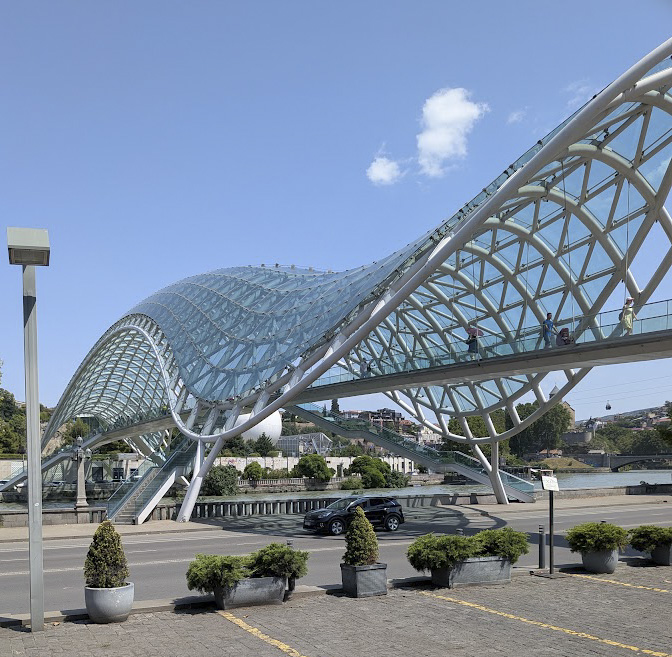
The modern Bridge of Peace spanning the Mtkvari caught our attention. Artistically constructed from glass and steel, this pedestrian bridge was opened in 2010. Connecting the old city of Tbilisi with Rike Park, it has become one of the architectural landmarks of modern Tbilisi.
I was closely observing the people walking across the bridge.
“What are you looking at so intently?” Shiamala asked.
Our guide smiled and explained:
“Many of the people walking here are foreigners. Since the outbreak of the Russia–Ukraine war, many Russians and Ukrainians have moved to Georgia, particularly Tbilisi. Consequently, house rents and the general cost of living have increased. Many Azerbaijanis also come here for entertainment and to visit casinos.”
I took her estimate of a ten per cent increase in prices as a general observation rather than a precise economic statistic.
Tbilisi is surrounded by hills, from whose heights one can enjoy a panoramic view of the city. When we ascended in a cable car, the city, spread out along the banks of the Mtkvari River, appeared before us like an enormous painting.
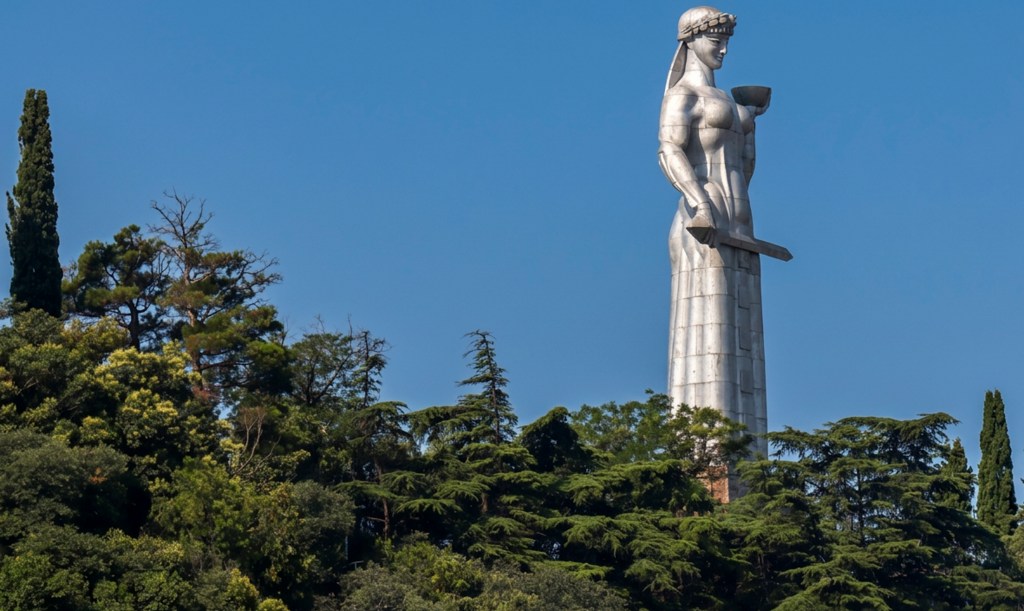
What fascinated me most was the colossal female statue known as the Mother of Georgia (Kartlis Deda).
Standing atop Sololaki Hill, the statue is twenty metres tall. Dressed in traditional Georgian attire, the woman holds a sword in one hand and a bowl of wine in the other.
“The sword symbolises the defence of the country against its enemies, while the wine represents the Georgian tradition of welcoming friends and guests,” our guide explained.
Designed by the sculptor Elguja Amashukeli, the statue was erected in 1958 to commemorate the 1,500th anniversary of the founding of Tbilisi. Originally made of wood, it was intended to be a temporary monument. However, owing to its popularity, it was decided to make it permanent. In 1963, it was covered with aluminium, and in 1997, the original statue was replaced with a new aluminium version.
The statue was conceived during the Soviet era under the leadership of Nikita Khrushchev. Following Stalin’s death, the relative liberalisation of Soviet society brought about a relaxation of the stringent restrictions previously imposed on art and literature.
However, Socialist Realism, the official Soviet artistic doctrine, had already been established during Stalin’s rule. Although Kartlis Deda emerged from this Soviet political and artistic environment, it embodies Georgia’s distinctive national identity.
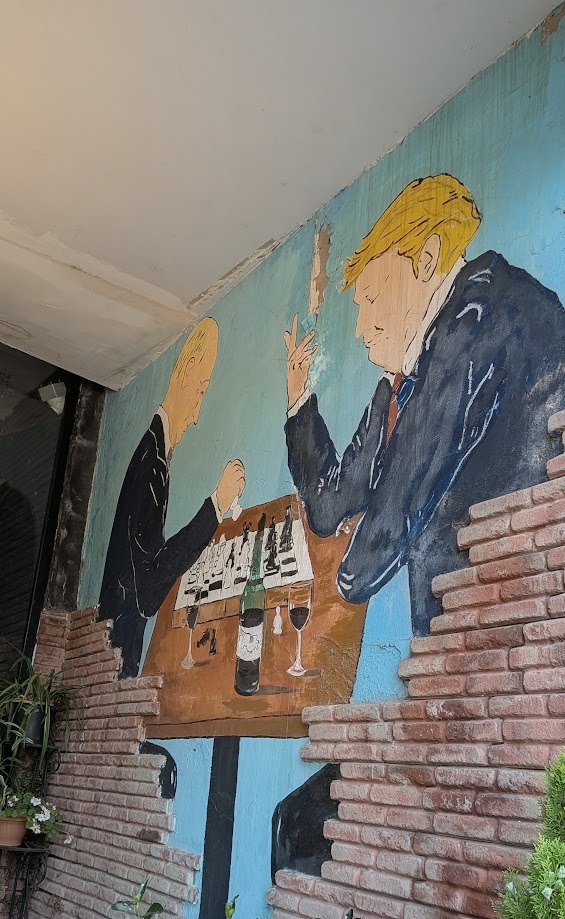
While walking through the streets of Tbilisi, a mural on the wall of a restaurant caught my attention, prompting me to stop for a while.
It depicted Russian President Vladimir Putin and American President Donald Trump, accompanied by bottles of alcohol, playing chess with the world map as their chessboard.
Is international politics merely a game of chess played by powerful nations? Are smaller countries simply pieces moved around the board?
The mural raised these questions in my mind.
Another legacy of the Soviet era lies beneath the streets of Tbilisi. During the Cold War, numerous underground shelters were constructed to protect the population from nuclear and other attacks. Hundreds of Soviet-era shelters have reportedly been documented beneath the city.
Some of the underground pedestrian passages through which we walked were now occupied by small shops and commercial establishments. We also saw small businesses catering to tourists.
Another distinctive feature of Tbilisi is its natural sulphur hot springs.
Their history did not begin in the thirteenth century but goes back much further, to the very origins of the city. According to a popular legend, King Vakhtang Gorgasali discovered these hot springs while hunting in the fifth century.
The name Tbilisi itself is derived from the Georgian word tbili, meaning warm. Historical accounts suggest that numerous bathhouses existed here as early as the twelfth century.
Even today, the traditional sulphur baths continue to operate in the Abanotubani district. In addition to hot-water bathing, massage services are also available. Having attracted locals and foreign travellers for centuries, this bathing tradition remains one of Tbilisi’s distinctive tourist experiences.
Another aspect of Tbilisi that appealed to me was its tranquil atmosphere, with its abundance of trees and parks.
In the places we visited, we never felt apprehensive about being robbed. People appeared relaxed and unhurried. We even saw some leaving their mobile phones on restaurant tables while stepping outside to smoke a cigarette. This, of course, was merely my personal impression of the city as a visitor.
One of the last major landmarks we visited was the Holy Trinity Cathedral of Tbilisi, also known as Sameba Cathedral.
Standing majestically on Elia Hill, this enormous cathedral was constructed between 1996 and 2004. Approximately 86 metres tall, it is one of Georgia’s largest religious buildings and a prominent landmark dominating the skyline of Tbilisi.
That evening, as we walked from our hotel to have dinner, we noticed a gathering of approximately 250 people carrying placards in a prominent part of the city.
I approached one of them and asked:
“What is the protest about?”
“It is a demonstration in support of Ukraine,” he replied.
The scene reminded me of Georgia’s recent history. Following the Russia–Georgia war of 2008, the regions of Abkhazia and South Ossetia have remained outside the control of the Georgian central government. Internationally recognised as parts of Georgia by most countries, these territories have a Russian military presence and together constitute approximately twenty per cent of Georgia’s land area.
For Georgia, therefore, its relationship with Russia is not merely a matter of foreign policy. It is inseparably intertwined with its territorial integrity, national security and history.
As I watched that small gathering on the streets of Tbilisi that evening, my thoughts returned to the statue of the Mother of Georgia that I had seen on the hilltop.
A bowl of wine in one hand to welcome guests.
A sword in the other to defend the homeland.
It seemed to me that these two symbols alone were sufficient to understand the spirit of Tbilisi.


மறுமொழியொன்றை இடுங்கள்