Our journey continued towards Tbilisi, the capital of Georgia. Along the way, we stopped at Ananuri, a beautiful historical complex of an ancient fortress and churches on the banks of the Aragvi River.
The principal buildings of the Ananuri fortress complex that we see today date back to the seventeenth century. It once served as an important stronghold of the feudal lords who ruled the Aragvi region. Its defensive walls, watchtowers and churches remain remarkably well preserved. Since 2007, Ananuri has been included in Georgia’s tentative list for designation as a UNESCO World Heritage Site.
However, beyond its history, a memorable legend is associated with this fortress.
According to local tradition, an enemy ruler’s forces once laid siege to the fortress for a prolonged period. Despite the lengthy siege, they could not starve its inhabitants into submission.
“Where have these people been getting their food and water all this time?”
The question puzzled the besieging army.
They suspected a secret underground passage connected the fortress to the outside world, through which food and water were being supplied.
They captured a young woman named Ana, who was believed to know the whereabouts of the passage, and tortured her to reveal its location.
But Ana refused to speak.
According to local legend, she chose to sacrifice her life rather than betray the fortress and its inhabitants. It is said that her name became associated with Ananuri in recognition of her sacrifice.
Although historical evidence has not conclusively established the story, it is a beautiful example of how courage and loyalty live on in a community’s collective memory through a woman’s name.
Several churches also stand within the fortress. Georgian history cannot be separated from Georgian Orthodox Christianity. The architectural features and worship traditions in its churches differ from those of Roman Catholic churches.
The Holy City of Mtskheta
Our next destination was Mtskheta.
Situated approximately twenty kilometres from Tbilisi, this ancient town stands at the confluence of two rivers, the Aragvi and the Mtkvari.
Mtskheta is no ordinary small town.
From the third century BC to the fifth century AD, it served as the capital of the eastern Georgian kingdom, then known as Iberia or Kartli. Archaeological evidence indicates that people lived in this region as early as the Bronze Age.
Although ancient Georgian chronicles claim that Alexander the Great conquered this region, not all modern historians accept this account.
In subsequent centuries, the region maintained close political, commercial and cultural ties with the Roman Empire and the Persian world.
When Christianity became the official religion of the Georgian kingdom in the fourth century AD, Mtskheta became an important spiritual centre. Even after the capital was transferred to Tbilisi, its religious significance remained undiminished.
To this day, Mtskheta remains a major spiritual centre of the Georgian Orthodox Church. In this respect, its importance can, to some extent, be compared to the Vatican’s spiritual significance for Roman Catholics.
Mtskheta’s principal historical monuments are also included in the UNESCO World Heritage List.
As we stepped out of our vehicle and walked towards the town, the magnificent Svetitskhoveli Cathedral came into view, surrounded by towering defensive walls.
“Wherever we go in Georgia, there seems to be another church!”
With that thought, I initially showed little enthusiasm and remained outside beneath a tree.
Then Shiamala called me.
Only after entering the cathedral did I realise its significance.
How significant, you might ask?
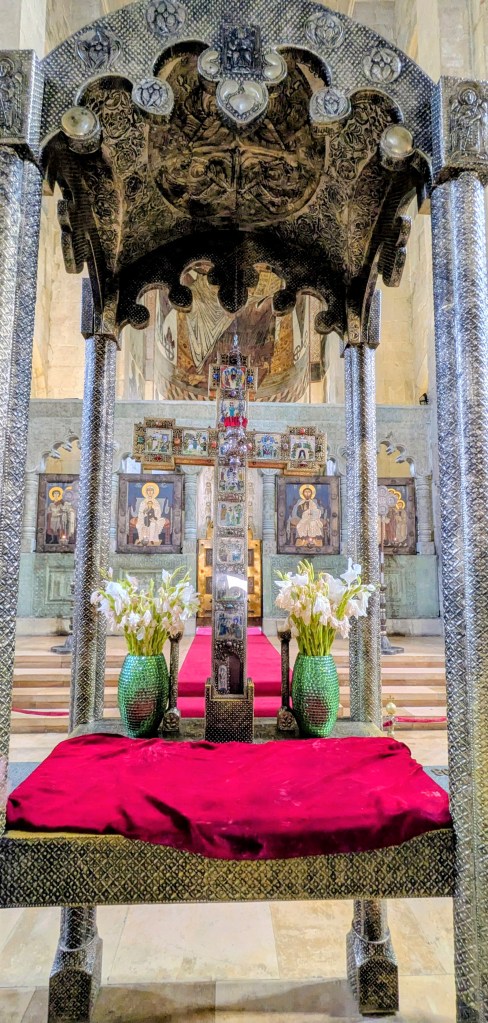
According to Georgian Christian tradition, this place is associated with a robe believed to have been worn by Jesus Christ at his crucifixion.
A fascinating religious legend lies behind it.
According to Georgian Orthodox tradition, a Jewish man named Elias, a native of Mtskheta, was in Jerusalem during the first century AD. Following the crucifixion of Jesus, he obtained Christ’s robe from a Roman soldier and brought it back to Georgia.
When Elias handed the robe to his sister Sidonia, she was so overwhelmed by grief at the death of Jesus that she died clutching it to her breast.
As no one could separate the robe from her grasp, she was buried with it.
It is said that a large cedar tree subsequently grew over her grave.
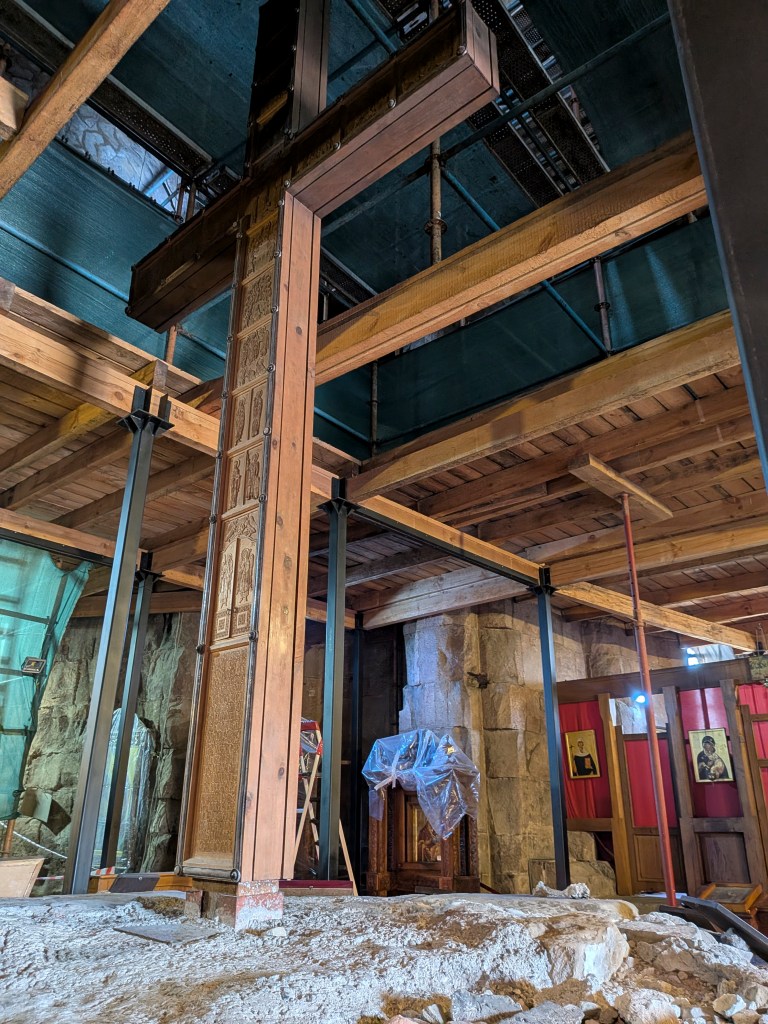
When Christianity spread throughout Georgia in the fourth century, the tree was reportedly felled, and seven pillars were fashioned from its timber to build an early church. According to tradition, one of these pillars miraculously rose into the air and descended into its rightful position only after Saint Nino offered her prayers.
Hence, the cathedral was named Svetitskhoveli, meaning “the Life-Giving Pillar.”
The first church was built on this site in the fourth century. Over the centuries, its structures were damaged and rebuilt several times. The magnificent Svetitskhoveli Cathedral we see today was largely built in the eleventh century, between 1010 and 1029.
As I entered the cathedral, I was captivated by its ancient frescoes and imposing stone architecture.
But what startled me even more was its floor.
The tombs of several Georgian kings lie beneath the cathedral floor. When I realised that we were walking over their graves, I felt uncomfortable even placing my feet upon them. As far as possible, I avoided stepping on the tombstones and walked around them.
How strange the passage of time is!
Men who once ruled an entire kingdom now sleep silently beneath the very floor we walk on.
When the centre of political power subsequently shifted to Tbilisi, Mtskheta lost its status as the capital. Just as Anuradhapura in Sri Lanka retained its historical and religious significance long after it ceased to be the political capital, Mtskheta continues to live in the Georgian people’s historical and spiritual consciousness.
Today, it may be a small town.
Yet, within that modest stretch of land where two rivers meet, layers of history lie one upon another: the ancient kingdom of Iberia, the influences of the Roman and Persian worlds, the birth of Georgian Christianity, the tombs of kings and a two-thousand-year-old legend surrounding the robe of Jesus Christ.
The greatness of certain cities cannot be measured by their geographical size, but by the depth of their memories. Mtskheta is one such city.
My original Tamil article was translated by Chatgpt and edited.


மறுமொழியொன்றை இடுங்கள்