My Tamil article was translated with the help of ChatGPT and edited .
The theme of conflict between brothers, so familiar to us from the Indian epic Mahabharata, also appears in ancient Greek mythology. Standing at the foot of Mount Kazbek, near the Russian border in Georgia, I even began to wonder whether Vyasar, the author traditionally credited with the Mahabharata, might have borrowed some of his stories from Greek mythology.
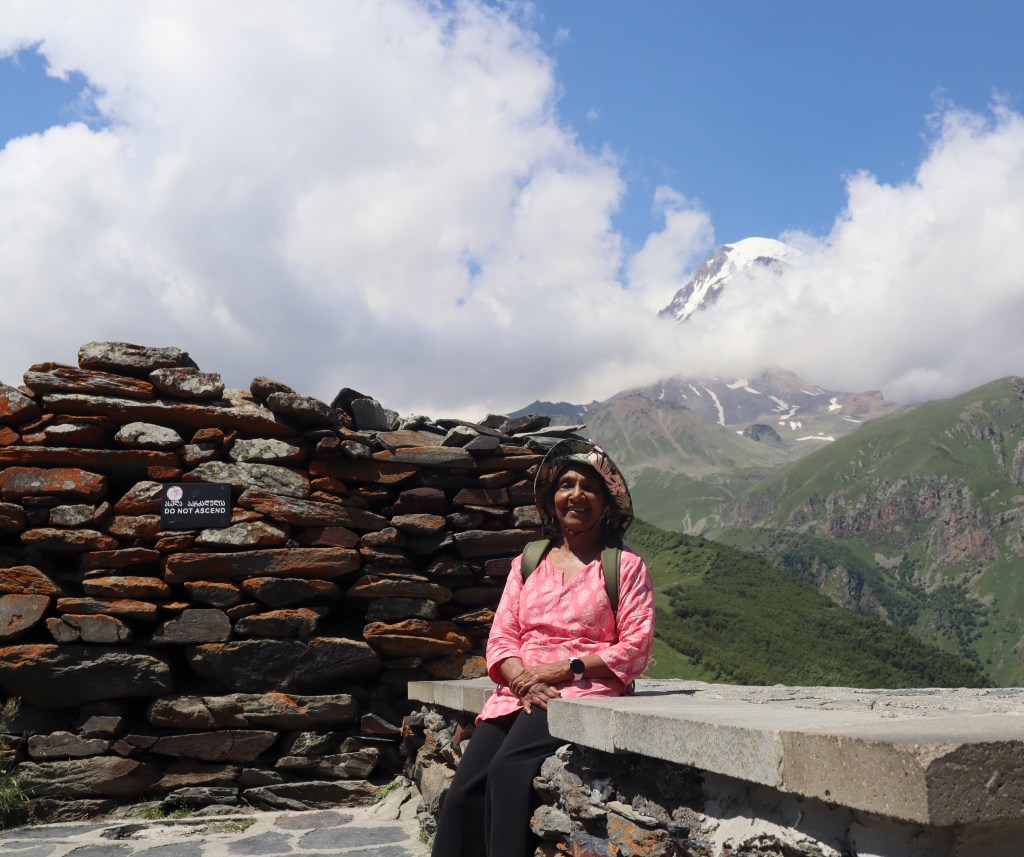
Mount Kazbek, permanently draped in snow, with white clouds resting upon its slopes, is a dormant volcano. Its last eruption is believed to have occurred around 750 BCE.
Situated in eastern Georgia, within the Caucasus mountain range that forms part of the geographical boundary between Europe and Asia, Mount Kazbek rises approximately 5,047 metres (16,558 feet) above sea level.
In Greek mythology, the generation of gods who preceded the Olympians were known as the Titans. They were the children of Uranus, representing the sky, and Gaia, representing the Earth. According to Greek tradition, there were twelve original Titans — six males and six females.
One of them, Cronus, married his sister Rhea. Among their children was Zeus, who eventually overthrew his father and became the supreme ruler of the Olympian gods.
Does this sound familiar? Is your head spinning with memories of our own epic stories?
Greek gods behaved remarkably like human beings. They fell in love, quarrelled, experienced jealousy, fought for power, and even formed relationships with mortal men and women, producing children through these unions. Perhaps this is why Greek mythology feels so familiar to those of us brought up on Indian epics.
When I think of the Titans, defeated and displaced from power by the new generation of gods led by Zeus, I am reminded of the Pandavas, who were driven from their kingdom.
One of the Titans’ descendants was Prometheus, a relative of Zeus.
According to Greek mythology, when human beings were deprived of fire, they suffered in darkness and cold. Unable to bear their suffering, Prometheus stole fire from Zeus and returned it to humanity.
Enraged by this defiance, Zeus ordered Prometheus chained to a mountain in the Caucasus.
Every day, an eagle arrived and devoured his liver. But because Prometheus possessed divine powers, his liver regenerated overnight. The following day, the eagle returned to repeat its gruesome punishment.
Thus, his suffering continued endlessly.
Eventually, the great Greek hero Heracles, better known by his Roman name Hercules, came to his rescue and freed him.
Prometheus was not merely the giver of fire. In Greek mythology, he also became a symbol of knowledge, technology, human progress and civilisation.
Amirani: The Hero of Georgian Mythology
Georgia has its own ancient oral tradition featuring a remarkably similar hero named Amirani.
According to Georgian mythology, Amirani was born to a female deity associated with hunting and a mortal man. He was born prematurely and, in some versions of the legend, underwent an extraordinary developmental process involving the wombs of different animals before emerging as a hero of exceptional strength.
Hearing this story reminded me of another episode from the Mahabharata: the miraculous survival of Parikshit, the unborn child of Uttara and Abhimanyu, who was saved while still in his mother’s womb.
Amirani fought evil forces and dragons, protecting humanity from danger. He was also celebrated as a hero associated with bringing fire and the knowledge of ironworking to human beings.
However, as his fame and power increased, pride took hold of him. Eventually, he dared to challenge God himself.
As punishment, he was chained inside a cave in the Caucasus Mountains.
Here, too, an eagle repeatedly attacked and devoured his liver.
But Amirani had one faithful companion — a dog named Qursha.
The loyal animal continuously licked the chains that bound its master, gradually weakening them. Yet whenever Amirani neared freedom, the chains were strengthened or renewed, preventing his escape.
And so, his punishment continued.
Prometheus and Amirani belong to different cultural traditions, yet their stories share striking similarities.
Both acted on behalf of humanity. Both were associated with fire. Both challenged divine authority. And both were punished by being chained to the mountains of the Caucasus.
Such myths are more than entertaining stories.
For centuries, Georgia has endured foreign invasions and domination by powerful empires. Perhaps legends such as that of Amirani helped nourish the Georgian people’s spirit of resistance, endurance and determination.
A Church on the Mountain
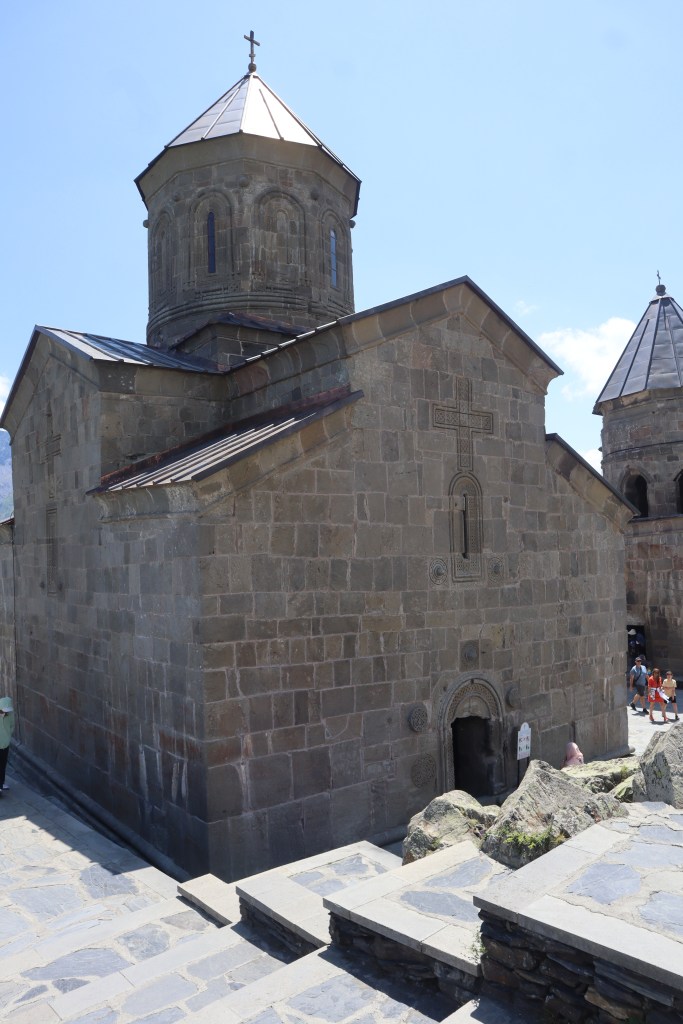
Standing before Georgetti Trinity Church, about 2,170 metres above sea level near the foot of Mount Kazbek, I gazed at the magnificent snow-covered mountain.
Snow-capped peaks rose before me. A deep valley stretched below, while an immense landscape unfolded in every direction.
A question immediately occurred to me.
Why would anyone build a church in such an isolated mountainous location?
Georgia adopted Christianity as early as the fourth century. After Armenia, it was among the earliest countries to make Christianity a state religion.
In later centuries, churches in remote mountainous locations also served as refuges where valuable religious objects and treasures could be protected during invasions and political instability.
But another question arose.
How did they choose the exact location for a church at such a height?
An old local legend offers an explanation.
According to the story, someone gave a piece of meat to an eagle. The bird was then released, and wherever it landed on the mountain was considered a sacred location suitable for building the church.
Whether historically accurate or not, the story reflects the fascinating relationship between religion, nature and folklore in Georgian culture.
Throughout history, Georgia has faced wave after wave of foreign invaders.
The Romans, Mongols, armies of Timur, Persians, Ottomans and, eventually, Russians all exercised influence or domination over Georgia at different periods.
Yet none of these powers succeeded in completely erasing the Georgian language, religion or cultural identity.
For a small country with a population of fewer than four million people to preserve its language, traditions and national identity while surrounded by powerful empires is no ordinary achievement.
Mountains and Dogs
This mountainous region also contains beautiful observation platforms constructed during the Soviet period.
The natural scenery is truly magnificent. Many visitors come here to mountaineer and trek. I imagined that the landscape would be even more spectacular during winter, when the entire region is covered in snow.
Another aspect of Georgia that surprised me was the freedom dogs enjoy.
Unlike in many Western countries, dogs in Georgia can often be seen roaming freely, much as they do in Sri Lanka or India.
Some are owned pets, others are street dogs, while still others wander through the mountains. Most appear peaceful and accustomed to human presence.
The mountain dogs were no exception.
After visiting a small waterfall, we travelled to Gudauri, a mountain resort town, where we stayed overnight.
We were given a room in a star-rated hotel built on the mountainside. Unfortunately, our room was located on one of the lower levels of the building.
Around midnight, dogs began barking continuously outside.
The barking went on and on.
I could hardly sleep.
The following morning, I complained to the hotel management.
“They are mountain dogs,” a staff member explained. “They come down looking for food and bark. There is nothing we can do about them. They are protected.”
“In that case, could you give us a room on the other side of the hotel?” I asked.
“Unfortunately, we have no rooms available,” came the apologetic reply.
Having spent much of my life as a veterinarian, what more could I say?
That night, when the barking began again, I suddenly remembered Amirani’s legend.
Perhaps one of those mountain dogs barking outside was none other than Qursha, Amirani’s faithful dog, still wandering through the Caucasus Mountains.
Perhaps, somewhere in those mountains, it was still trying to free its master, licking the chains that had held him captive for centuries.
With that thought in my mind, I put on my earphones, listened to some music, and eventually drifted off to sleep.


மறுமொழியொன்றை இடுங்கள்