Before writing about Georgia, I must begin with a story about the country that has remained in my mind for many years.
Many years ago, I read a story about a woman from another country who married a Georgian man. After their wedding night, she became thirsty and asked for some water. Instead, her husband’s family gave her wine. Her thirst was not quenched; in fact, it became worse. She asked again for water, but they kept giving her wine. By morning, according to the story, the poor woman had died of thirst, her tongue completely dry.
I have no idea how much truth there is in this story. But after spending two days in Georgia, I began to understand where the idea behind it might have come from.
Just as Azerbaijan is a country rich in oil, Georgia could be described as a country where wine flows like a river. Vineyards stretch across much of eastern Georgia. Just as agriculture was once deeply intertwined with everyday life in our Chunnakam, Jaffna region, vineyards and winemaking here are woven into Georgian life.
Traditionally, families made wine at home as a cottage industry, fermenting it in large earthenware vessels. That ancient tradition continues even today. At the same time, large wineries now use modern metal tanks and scientific methods to produce wine on an industrial scale.
Georgia and Russia
After the Soviet Union broke apart into fifteen independent republics, many began turning politically and economically toward Europe. In Georgia, the desire for closer integration with the European Union also grew strongly. This became a major source of tension in Georgia’s relationship with Russia.
Two regions of Georgia—Abkhazia and South Ossetia—are no longer under Georgian government control, and Russian military forces are stationed there. Together, these territories constitute roughly twenty per cent of Georgia’s internationally recognised territory.
Perhaps because of this, from the tour guides I met to many ordinary Georgians, I encountered strong resentment towards Russia. Yet many Russians live in Georgia, and many others visit as tourists. I found this contrast between political hostility and ordinary human interaction particularly interesting.
A Unique Language and Script
Even before visiting Georgia, I had heard the Georgian language was distinctive, though I knew little beyond that.
Georgian belongs to the Kartvelian language family, and its writing system is remarkably distinctive. At first sight, its rounded shapes and flowing characters make it difficult to confuse with almost any other script.
What surprised me even more was learning that Georgian has historically had three different writing forms. They were used during different periods and for religious and royal documents before later forms came into wider everyday use. The script most commonly seen today is known as *Mkhedruli*.
For a country with a population of only around four million, it is remarkable that such a distinctive language and writing tradition has been preserved so strongly. Even during the Soviet era, Georgian remained an important language in the country.
Telavi — The Capital of Wine Country
Our first destination was Telavi, the principal city of Kakheti, Georgia’s most important wine-producing region. It was once an important political centre of eastern Georgia. Its fortress walls, churches and palaces still stand as reminders of its former importance.
After Georgia came under Russian domination, Telavi gradually lost much of its political importance and became a relatively small town.
We stayed there for one night.
The next day, we learned how to make traditional Georgian bread.
When I was studying in Sydney, I once worked in an Indian restaurant. I struggled hopelessly to make perfectly round chapatis and gave up the job after a month! Georgian bread, however, proved much easier. The elongated dough had to be pressed against the inside wall of the oven, and surprisingly, I managed that quite well.
A Winery Carved into a Mountain
From there, we were taken to an enormous winery.
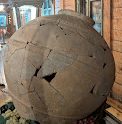
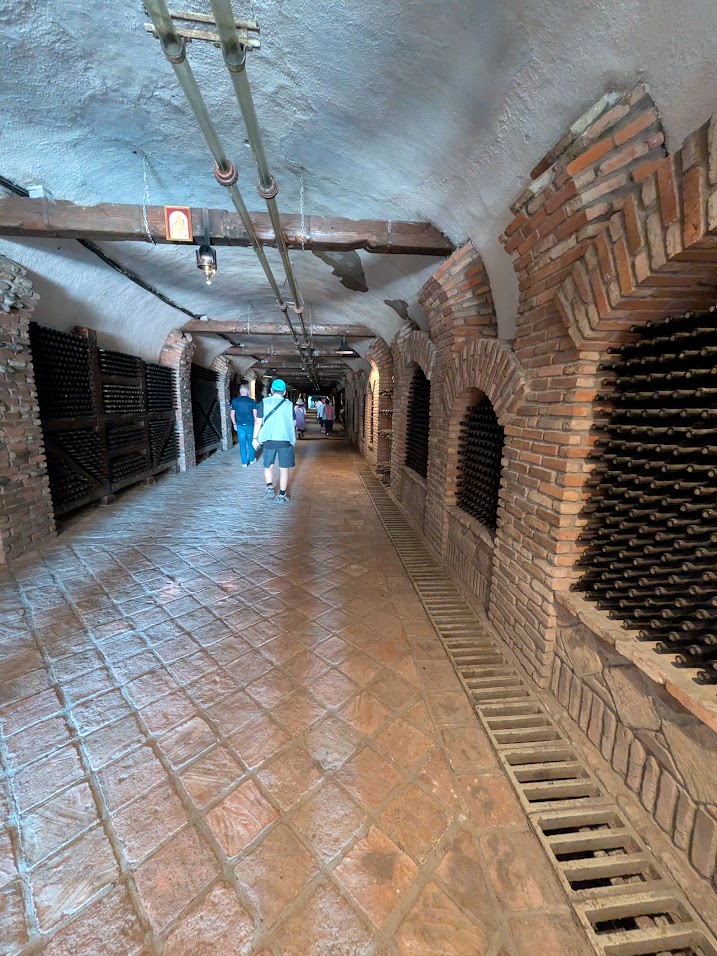
During the Soviet period, in the 1960s, they excavated kilometres of tunnels into the mountain to produce and store wine. We were told that wine from this facility was distributed across much of the Soviet Union. The facility also displayed ancient earthenware vessels used for winemaking thousands of years ago.
For Georgians, wine is not merely an alcoholic drink. It is part of their food, hospitality, family life, celebrations and traditions. In other words, wine is part of their cultural identity. During celebrations, people may drink wine for many hours. However, we were told that becoming so drunk that one cannot walk is not considered something to be proud of.
I asked one of the young men there:
“What is the legal drinking age in your country?”
“Eighteen,” he replied. “But many of us begin tasting wine when we are twelve or thirteen.”
“How much would you drink at a feast?”
“A litre of wine would be quite normal. Sometimes people drink wine from animal horns. Of course, the larger the horn, the more wine it holds!”
“Is there a difference between men and women?”
“Not really. But because of differences in body size, women generally drink less,” he said.
Then Shiamala asked:
“What about liver disease in your country?”
He laughed.
“We don’t drink every day!”
From Animal-Skin Bags to Bottles
We were told that in earlier times, wine in Georgia was transported in bags made from animal skins and carried for sale on ox carts or horse-drawn carts.
Hearing this reminded me of the days when people transported and sold water in North Chennai.
“Today, we produce millions of bottles of wine,” our guide said proudly.
What we normally call “red wine” is sometimes referred to locally as “black wine.” Similarly, some wines that we would classify as white wine appeared golden or amber in colour.
We were offered wine for tasting early in the morning. At that hour, I had little enthusiasm for drinking. About half the people travelling with us were of Chinese heritage. Some of them merely touched the wine to their tongues to taste it without actually drinking it. Only another Australian and I drank a little.
A Poet’s Wine Estate
Afterwards, we visited a wine museum that had once been a private mansion.
The estate was associated with one of the pioneers who helped transform Georgian winemaking from a centuries-old household tradition into a modern industry. We were told that he was a poet with connections to the Russian imperial service. After travelling to France and observing European winemaking techniques, he helped introduce and develop more modern methods of wine production in Georgia.
He later became wealthy and influential. His mansion, surrounded by beautiful parkland, is now a museum.
And there, once again, we were offered wine!
We then visited another wine museum, where they explained the development of Georgian winemaking—from the ancient practice of fermenting wine in earthenware vessels to the later use of large oak barrels and modern production techniques.
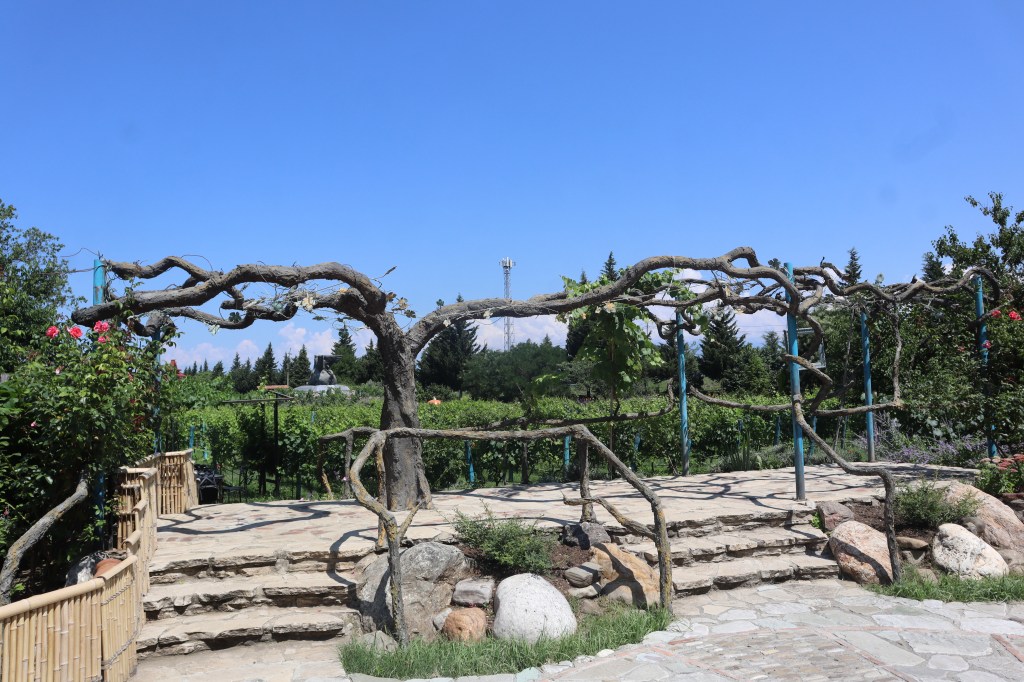
We were also told that a grapevine there was around 300 years old and still alive, and that its grapes were still used for winemaking. They were also propagating new vines from this ancient plant.
I already knew a little about winemaking before visiting Georgia. But after travelling through the country for two days, I began to feel as though I had become a wine expert myself!
Roses Standing Guard Over the Grapes
Another interesting feature I noticed in the vineyards was that rose bushes had been planted at the ends of the rows of grapevines.
“Why do you plant roses here?” I asked.
I was told that certain diseases affecting grapevines may show visible symptoms on roses, allowing growers to notice potential problems early and take action.
Where white grapes grew, I noticed yellow roses; where dark or red grapes grew, there were red roses.
Wine and Mythology
How much scientific value this practice has today is another matter. But the roses certainly added beauty to the vineyards and seemed to preserve a tradition followed for generations.
In Georgia, wine is not merely an agricultural product. Myths and legends have also grown around it.
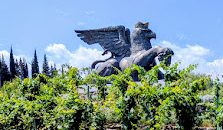
We heard stories about mythical creatures such as the Griffin, with the head of an eagle and the body of a lion, linking grapes and wine to the divine world. A large statue of such a creature was also displayed there.
It was clear how profoundly the concept of wine as a cornerstone of Georgian civilization—and as a divine gift—has become ingrained in their culture. They also eagerly took the chance to emphasize this idea to tourists like us.
Wineries, vineyards, ancient clay vessels, underground tunnels, museums and mansions—wherever we went, wine seemed to follow us.
And so, our first two days in Georgia **began with wine and ended with wine**.
Then I remembered again that story I had read many years ago.
At last, I could understand a little better why, when that thirsty woman asked for water, they kept giving her wine!
My Tamil Article translated by ChatGPT


பின்னூட்டமொன்றை இடுக