The veterinary hospital began its morning duties amid a medley of sounds—dogs barking, cats meowing, more than fifty staff members speaking, and the chatter of people who had brought in their pets.
It was a Tuesday, one of our busiest days.
After examining the dogs and cats already admitted to the wards, I made my way to the outpatient consulting room. I was slightly late because I had to collect blood samples from some of the hospitalised animals.
I picked up the first file and called out the dog’s name and its owner’s name over the loudspeaker.
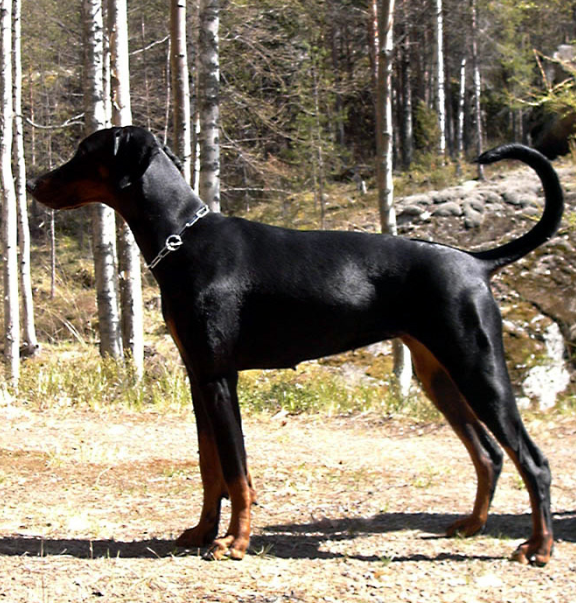
Within moments, an attractive young woman of about twenty-five entered the room with a black Doberman. She introduced herself as Jenny. After the customary Australian exchange of greetings, I asked her about the dog.
The dog wagged his tail and looked at me curiously.
Something in that look seemed to say, ‘’I have come into your hands. Now you are going to decide what happens to my life. ‘’
“What is his name?”
“Tyson,” she said.
Tyson came closer and sniffed my hand. I stroked his head.
“What seems to be the problem?”
“Doctor, Ryson is eating well, but he has been coughing for the last three days. I’m worried that perhaps a piece of bone is stuck in his throat.”
Thinking Jenny’s suspicion was quite reasonable, I asked, “Have you given him any bones recently?”
“No, Doctor.”
“In that case, it could be kennel cough, an infection he may have picked up from another dog.”
I gently palpated Ryson’s throat. He did not cough.
“It is rather like the cold and cough we humans get. There may be nothing to worry about.”
Then I examined his abdomen. It seemed somewhat distended. I tapped it gently with my fingers, looking for any sign of fluid accumulation, but detected none.
“Perhaps it is simply food,” I thought.
I placed my stethoscope against his chest and listened.
Something was wrong.
His heart was beating unusually fast.
“Jenny, I’m sorry, but I think Tyson’s heart may be enlarged, and it could be causing him some distress. His cough may be related to that.”
Jenny’s face immediately fell.
“Don’t worry yet. Let’s take an X-ray and see.”
“Doctor, do you really think his heart is enlarged?” she asked, her eyes filling with tears.
“I sincerely hope I’m wrong. But the X-ray will give us a clearer answer.”
Distressed, Jenny stroked Ryson. He lowered his head, sniffed her feet and wagged his tail.
I called the nurse. I asked Jenny to remain seated while we took Tyson to the X-ray room.
Getting him there was no easy task. He did not want to leave his mistress and kept looking back at her longingly. Jenny stroked him reassuringly before sending him with us, almost like a mother sending a reluctant child off to school.
Tyson was a large dog. We had to lift him onto the X-ray table and keep him still. Normally, we would sedate a large dog for such a procedure. But I wanted to make the diagnosis quickly, and if Ryson really did have serious heart disease, sedation itself could carry risks.
Fortunately, my nurse, Sam, was not only a strong man but also trained in karate. With his help, the procedure proved easier than I had expected.
As soon as I developed the X-ray in the darkroom and looked at it, I experienced two conflicting emotions—satisfaction and sadness.
My clinical examination had led me to suspect an enlarged heart even before taking the X-ray. The image confirmed my diagnosis, giving me the professional satisfaction of knowing that my judgement had been correct. But the same X-ray also showed me that this voiceless creature was fighting a battle for his life.
Tyson’s enlarged heart occupied nearly three-quarters of his chest. It appeared almost round, like a large pot. The heart’s chambers were grossly enlarged, giving it the appearance of an inflated ball.
It was severe cardiomegaly, and the disease was already far advanced. Dobermans also have a hereditary predisposition to certain forms of heart disease.
I showed Jenny the X-ray.
She stared at it in shock. Tears gathered in her eyes.
“Jenny, I’m very sorry. To tell you the truth, Tyson’s heart is in a very serious condition. I’m amazed he’s managed to behave so normally until now. At this stage, I don’t think medication is going to help him very much.”
“Doctor,” Jenny said, looking at the X-ray, “your X-ray shows that Tyson’s heart is enormously enlarged. But he has already shown me many times, through what he has done, just how enormous his heart really is.”
As she spoke, tears began rolling down her cheeks.
I looked at her, puzzled by what she meant, and handed her a tissue from the box.
“Thank you.”
I felt deeply sorry for her.
Then Jenny told me Tyson’s story.
Tyson had originally been a night guard dog at a timber yard near Jenny’s home. This was before security cameras became commonplace. In those days, car yards, timber yards and similar businesses often relied on dogs to guard their premises at night.
Because Jenny lived next door to the timber yard, she occasionally gave Ryson food at night. She would pat him and talk to him, and over time a bond developed between them.
During the economic downturn in Australia in the late 1980s, the timber business closed and moved elsewhere. At the new premises, they no longer needed a guard dog. Dogs trained for security work were not always easy to rehome. Some could be restless or aggressive in an ordinary domestic environment. The owners were uncertain what to do with Ryson.
Jenny told them about the bond she had developed with him and offered to take him.
The owners agreed, but only after Jenny signed a legal document stating that they would not be responsible if the dog ever bit her. Ryson came home with Jenny.
Three years earlier, during a Melbourne winter, Jenny had been working as a security officer in a company warehouse in the city.
In winter, darkness falls early in Melbourne. By six in the evening, the streets can already be dark.
One night, after finishing work, Jenny caught the train back to Clayton. She arrived around eight o’clock. Her home was within walking distance of the station. The streets were deserted and silent. Between the road and her house lay the abandoned timber yard site, now an empty block overgrown with bushes as tall as a person.
As Jenny walked past the overgrown land, a man suddenly sprang from the darkness. He grabbed her and dragged her towards the bushes.
Jenny was terrified.
He was a strongly built man, perhaps around thirty. Holding her tightly, he covered her mouth with one hand and dragged her further into the darkness.
She could do nothing.
She fell to the ground.
He threw himself on top of her.
As they fell, his hand slipped away from her mouth.
“Tyson! Tyson!” Jenny screamed.
Tyson heard her.
He leapt over the fence and raced toward them.
The dog seized the man by the leg and pulled him away from Jenny. As the attacker turned his attention towards the dog, his grip on Jenny loosened.
She managed to scramble away, but Tyson did not stop.
He continued attacking the man from behind until the man, desperate to escape, ran away, leaving even his shoes behind.
“He saved me that night without allowing so much as a scratch to come upon me,” Jenny said.
She wrapped her arms around Ryson and began to cry.
“Ever since that night, Tyson has slept outside my bedroom door like a personal bodyguard. I could go anywhere with him. I even felt safe walking through parks at night as long as Tyson was beside me.”
Listening to her story, my own heart grew heavy. Still, I had to do what my profession required.
“Jenny, I’m very sorry. Tyson has protected you and stood beside you all these years. But the time has come when you may have to say goodbye to him.”
She stared at me.
“What are you saying, Doctor?”
“Have you heard of euthanasia?”
Jenny said nothing.
She began to sob.
“Tyson has given you his love and protected you. Now he is suffering from a serious disease. Do you want to watch him struggle as his condition worsens? Through euthanasia, we can allow him to fall peacefully into his final sleep and spare him further suffering.
“You don’t have to decide today. You can take him home and think about it. If you prefer, I can give him medication temporarily.”
“Is there no other way?”
“When small dogs develop heart disease, we can sometimes manage them with medication for months, even years. But Tyson’s disease is already very advanced. And in his breed, this kind of heart disease can have a hereditary basis.
“A magnificent dog like Tyson will eventually be coughing continuously, and the coughing will often become worse at night.”
“Doctor…”
Jenny’s voice broke.
She could say no more.
Her throat tightened, and tears continued to fall.
Finally, she agreed to euthanasia and signed the consent form.
Jenny stood motionless, holding Tyson tightly.
Ryson looked only at her.
I inserted the needle into a vein in his foreleg and slowly administered the green solution.
Ryson’s eyes remained wide open, fixed upon Jenny.
Then, without a struggle, his body became still.
His heart stopped beating.
But the heart of that voiceless creature—a heart that had earned an unforgettable place in Jenny’s own—would continue to speak for the rest of her life.


மறுமொழியொன்றை இடுங்கள்