From Baku, the capital of Azerbaijan, our next journey took us towards the ancient city of Shamakhi.
Shamakhi was not a former capital of modern Azerbaijan. Rather, during the medieval period, it served as an important capital of the Shirvanshahs, the dynasty that ruled this region. Over the centuries, the city was repeatedly devastated by powerful earthquakes and wars, only to rise again from the ruins. Following the destruction caused by the earthquake of 1191, the seat of the Shirvanshah rulers was moved to Baku for a period.
The natural landscape around Shamakhi, with its proximity to the mountains, was strikingly different from the dry terrain of Baku on the Caspian coast.
We had spent the previous five days in Baku, which is regarded as the world’s lowest-lying national capital. It stands approximately 28 metres below sea level.
Shamakhi lies about 120 kilometres from Baku, and along the way we visited several places of historical importance.
The Mausoleum of Diri Baba
Our first stop was the Diri Baba Mausoleum.
Built into the side of a rocky hill, this two-storey structure appears almost to be part of the mountain itself. It was constructed in 1402, during the reign of Shirvanshah Ibrahim I, and is associated with a revered Sufi mystic who lived around the end of the fourteenth century. Historical tradition holds that the mausoleum was built in his memory after his death.
Situated near an ancient Silk Road route, the site attracted merchants, travellers and pilgrims for centuries.
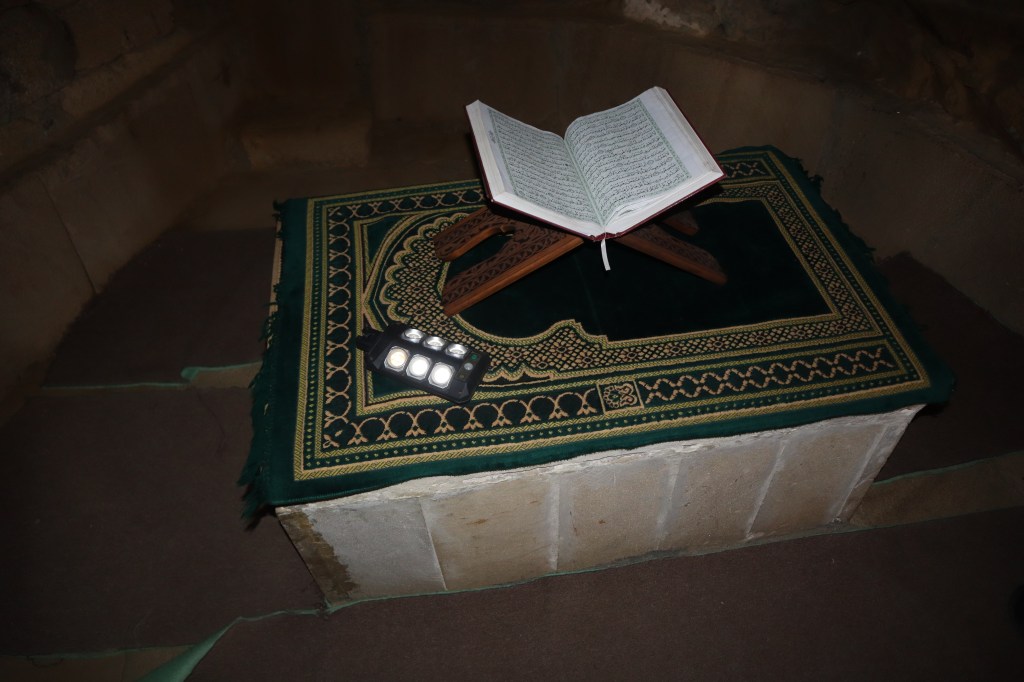
After climbing to the upper level, we saw a copy of the Quran placed near the tomb. We were told that it was an old Quran associated with the holy man.
When I came outside, an old cemetery stretching across the grassland opposite the mausoleum caught my attention. There seemed to be graves everywhere.
I asked our guide about them.
He smiled.
“People believed that if they were buried close to this holy man’s tomb, they would reach paradise. So the dead were brought here from many different places to be buried.”
Apparently, people were not prepared to depend entirely on their own accumulated merit. They hoped to borrow a little of the Sufi saint’s holiness to help them reach heaven.
These days, we borrow money to get through life. Perhaps in those days, people tried to borrow spiritual merit to get into paradise.
“The cemetery was used for many centuries, but it has now been abandoned,” our guide added.
The Juma Mosque of Shamakhi
Our next stop was the Juma Mosque of Shamakhi.
Its origins date back to AD 743. It is regarded as the oldest mosque in Azerbaijan and one of the oldest Islamic places of worship in the Caucasus.
Over the centuries, the mosque has been damaged and rebuilt several times. Severe earthquakes that struck Shamakhi during the nineteenth and early twentieth centuries caused extensive destruction. The mosque was also set on fire during the violent conflicts of 1918. It subsequently underwent several restorations, with the most recent major reconstruction completed in 2013.
This region had once formed part of Caucasian Albania, an ancient political and cultural territory. Arab rule later reached the region, bringing with it the growing influence of Islam.
There were not many people inside when we visited. With its tall minarets and spacious prayer hall, the building seemed to me a living monument to a religious tradition that had survived for centuries despite earthquakes, wars and political upheavals.
The Palace of the Sheki Khans
From Shamakhi, we continued our journey towards Sheki.
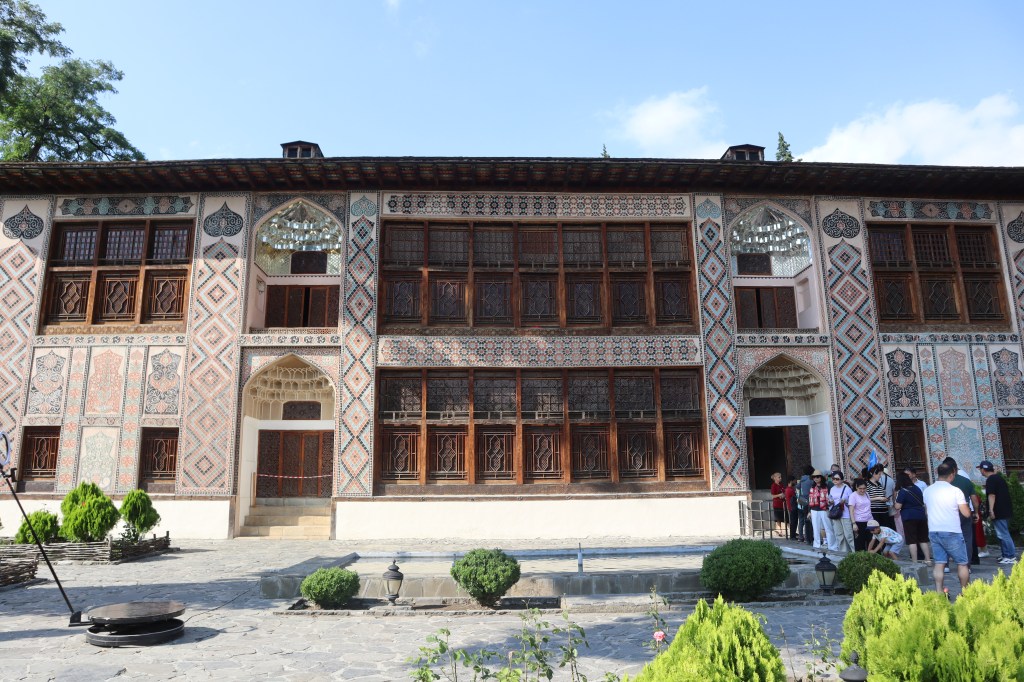
The Palace of the Sheki Khans, built in the eighteenth century, is one of the city’s most celebrated buildings. Together with the historic centre of Sheki, it was inscribed on the UNESCO World Heritage List in 2019.
Standing amid old trees in a peaceful garden, the palace was relatively small. Yet what it lacked in size, it more than made up for in artistic beauty.
I was particularly fascinated by its colourful windows, made using a traditional technique known as shebeke.
Tiny pieces of coloured glass are fitted into intricate wooden frames without using nails or glue. The pieces lock into one another to form elaborate geometric patterns.
We also visited a workshop where craftsmen were making these decorative panels. Watching them at work was fascinating.
Hundreds of tiny pieces of wood and coloured glass were assembled one by one until they became an enormous, intricate window. It reminded me of putting together a giant jigsaw puzzle.
The Royal Fruit — The Pomegranate
In Azerbaijan, the pomegranate is more than simply a fruit. It is one of the country’s important cultural symbols, associated with abundance, prosperity, love and fertility.
Pomegranate juice was remarkably inexpensive. In some places, it seemed to cost less than bottled water.
Knowing that pomegranates are rich in antioxidants, Shiamala often chose pomegranate juice instead of water.
I also noticed many pomegranate motifs decorating the walls and interiors of the palace.
I asked our guide about them.
“The pomegranate is our royal fruit,” he said.
“Why?” I asked.
Smiling, he pointed to the top of a pomegranate.
“Look at it. It has a crown on its head!”
That seemed as good an explanation as any.
He went on to explain that the numerous seeds inside the fruit represent abundance and fertility. Because the seeds are packed closely together, the pomegranate is also used as a symbol of family bonds and social unity.
Where Was the Khan’s Harem?
When I heard that this was the palace of a Muslim ruler, I assumed there would be a separate section containing numerous rooms for his wives.
So, as I walked around the palace, I kept looking for them.
I searched everywhere.
Nothing.
Eventually, I asked our guide.
“Wasn’t there a harem with many rooms?”
He laughed.
“There was no large harem here of the kind you are imagining. Court traditions were not identical among all Muslim rulers,” he explained.
I looked at him, still not entirely convinced.
Were there really men who failed to make use of all the privileges their religion allowed them?
I kept that question to myself.
Kish — Traces of an Ancient Christianity
About five kilometres from Sheki lies the small village of Kish.
It is an important site associated with the early Christian history of Caucasian Albania.
The site occupied by the Church of Kish appears to have been a place of worship since ancient times. Archaeological investigations have uncovered evidence of religious activity there even before the arrival of Christianity. Studies suggest that much of the church building visible today dates from the medieval period.
According to local Christian tradition, St Elishe, or Elisha, came to this region during the first century, preached Christianity and established a place of worship here.
However, this belongs to religious tradition rather than firmly established archaeological history. Archaeological research does not confirm that the church building standing there today dates from the first century.
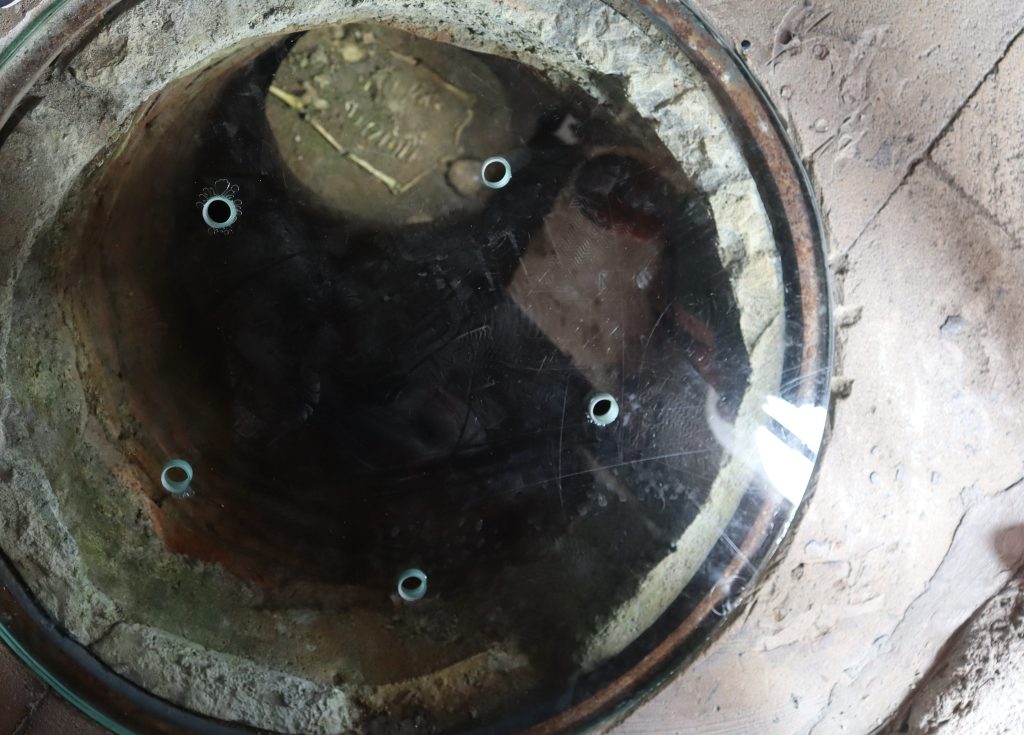
When we entered the church, our guide asked us to look through glass panels set into the floor.
Beneath them were ancient graves and human skeletons uncovered during archaeological excavations.
Some of the skeletons appeared to be around two metres long. Azerbaijani and Norwegian researchers carried out excavations at the site in the early 2000s.
Carbon-dating and archaeological investigations have suggested that ritual activity at the site may reach back as far as the third millennium BC, while much of the present church structure belongs to the medieval period.
Looking at those ancient skeletons beneath my feet, a question arose in my mind:
As long as religions exist, is it possible to eliminate religious conflict entirely?
Throughout history, religion has rarely been a matter of faith alone. It has often been intertwined with political power and social influence. As new religions and new rulers emerged, older beliefs disappeared, changed, or became absorbed into newer religious traditions.
The ancient skeletons lying silently beneath the Church of Kish seemed to remind me that although human beliefs continually change, human history itself continues to accumulate, layer upon layer.
Christian minority communities still live in Azerbaijan today, including people belonging to Russian and Georgian Orthodox traditions.
Our guide also explained that during periods of Arab rule, Christians and other “People of the Book” were, in certain places and periods, permitted to continue practising their religion in return for paying a special tax.
Farewell to Azerbaijan
It was now time for us to leave Azerbaijan and enter Georgia.
Our border crossing was in a mountainous area. To reach the immigration and customs post, we had to climb a considerable number of steps.
And we were not climbing them empty-handed.
We had our heavy suitcases to drag behind us.
We waved goodbye to our Azerbaijani guide and began the climb towards the border post.
As I struggled upwards, something a friend had once told me suddenly echoed in my mind:
“You can travel around the world only for as long as you have the physical strength to carry your own luggage.”
As the two of us dragged our suitcases up those steps, however, instead of contemplating the philosophy of ageing and world travel, a far more practical thought entered my mind:
“At least they could have repaired these broken steps!”
Once we had conquered the steps, crossing the bridge over the river was relatively easy.
Eventually, we passed through Georgian immigration and customs and climbed into the vehicle waiting for us on the other side.
As we travelled towards our next country, we carried with us memories of our days in Azerbaijan: the wind from the Caspian Sea, ancient mausoleums clinging to mountainsides, mosques that had survived the passage of centuries, colourful palace windows, and ancient human beings sleeping beneath glass floors.
We had crossed a border and left Azerbaijan behind.
The border marked the end of one country, but its history and memories crossed into Georgia with us.


பின்னூட்டமொன்றை இடுக