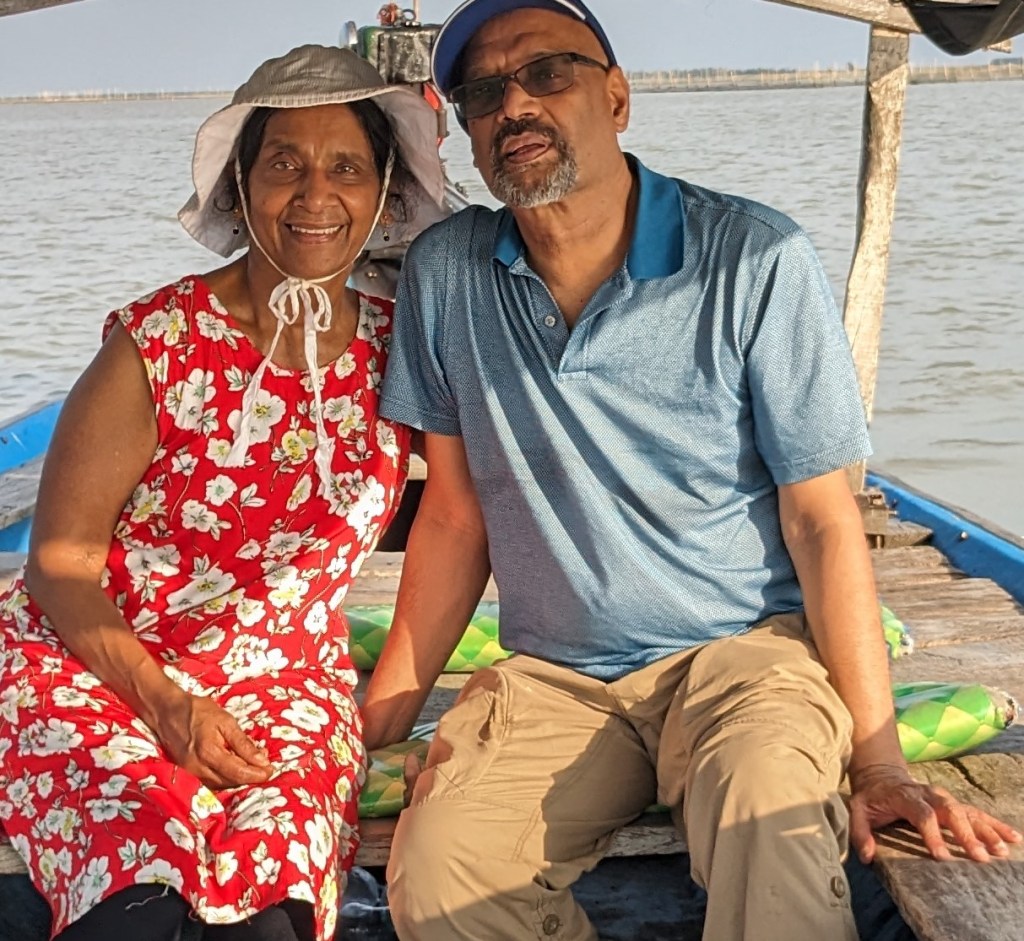
Nadesan
In May 2018, I received a heavy blow to the head.
Bewildered, not knowing who had struck me, I instinctively rubbed the place where I imagined the blow had landed and looked around. There was nobody there.
Confusion. A feeling that the ground beneath me had suddenly shifted.
My wife, Shiamala, who had always been remarkably healthy and energetic, had been struck by a form of cancer about which we knew very little.
Most illnesses are rather courteous visitors. They send you a letter first, perhaps telephone you afterwards, and only then arrive at your doorstep. We had become accustomed to illnesses such as heart disease, diabetes and stroke, which often announce their approach with warning signals.
But this was different.
It was like a bomb exploding without warning, shattering the calm of our lives.
Illness can strike anyone, anywhere, at any time. Such experiences happen to countless people. You may therefore wonder: what is unusual about this? Why should I write or speak about it?
Australia is a developed country with excellent medical facilities, good hospitals and highly trained doctors. Moreover, Shiamala herself is a doctor. You might reasonably assume that navigating such a situation would therefore be easier for us.
I thought so too.
But what happened was quite different from what I had expected. That is the reason I am writing this.
This essay is a red warning flag marking the iceberg that struck the ship of our lives.
Almost every morning, between six and seven, Shiamala would walk at least four kilometres with our Labrador, Cindy. I, on the other hand, was accustomed to getting out of bed around eight.
When she brought me my morning coffee, she would invariably mutter her favourite mantra:
“Lazy man!”
I would defend myself with my own theory.
“Even a rabbit, despite being one of the fastest animals, lives only about five years even if it escapes the hunter. But crocodiles and tortoises can live for hundreds of years because they do not waste their energy.”
Since I could reach my workplace within five minutes, I had no reason to hurry in the mornings. I would walk with Cindy in the evenings instead, and often stay awake beyond midnight, reading or writing.
I have always held an unshakeable belief that every human being is different.
On the morning of 23 May, after returning from her walk with Cindy, Shiamala complained of pain near her left hip. Thinking that she had probably strained a muscle, I took her to the Chinese massage therapist whom I occasionally visited.
When the pain persisted for a week, and knowing that her birthday was approaching the following month, I presented her with a slim pink walking stick that could almost fit into a handbag.
When she went to work carrying it, one of her patients, a Sri Lankan woman, decided—with the best of intentions—to arrange some treatment for her doctor. She took Shiamala to a Filipino massage therapist.
The consequences of that massage appeared dramatically on her leg and thigh: dark bruises resembling patches of congealed blood.
Still, the pain continued.
Eventually, there was no alternative but to have an X-ray. It showed a lesion in the femur. An MRI followed and confirmed that an area of bone roughly the size of a coin had been eroded.
A biopsy was then performed to determine what it was.
The investigations revealed that the tumour arose from plasma cells, cells derived from the bone marrow. The condition was called a **plasmacytoma**. When the disease is present in multiple sites, it is called **multiple myeloma**.
During this period, I was already involved in something else I had planned. I went to meet Dr David Young, an Australian doctor who had worked hard to establish a new emergency treatment unit in Batticaloa.
After speaking with him and making my contribution to the hospital project, I casually asked:
“Could you have a look at an X-ray?”
He looked at it immediately.
“Bring her here today,” he said.
That very evening, I took Shiamala to see him. After examining her, he contacted a friend, an orthopaedic oncology surgeon, and referred her to him.
Within two weeks, they arranged surgery.
We were told that part of the femur would have to be removed and replaced with a titanium prosthesis as part of a hip replacement.
During the first operation, they removed the affected section of bone. But they could not insert the new titanium prosthesis.
The reason?
Shiamala’s femur was smaller than expected, and they did not have a titanium implant of the appropriate size available.
A second operation was therefore scheduled for the following day.
Before operating on a dog, I would measure everything beforehand and make sure that I had the appropriate equipment ready.
So, a question kept circling in my mind:
Could a well-known surgeon in Melbourne not have determined the diameter of the femur before beginning the operation?
The next day, Shiamala underwent surgery again, and the prosthesis fit successfully.
Thus, she endured two operations on two consecutive days.
Two weeks later, further investigations were carried out to determine whether the cancer had spread elsewhere in her body. We then went to the Peter MacCallum Cancer Centre, one of Melbourne’s best-known cancer hospitals.
Sitting in a wheelchair while my friend Kanthan pushed her along, Shiamala said to him:
“So many patients have told me that they are still alive because I detected their cancers early.”
As I listened, passages from Russian Author Alexander Solzhenitsyn’s *Cancer Ward* drifted through my mind. In the period depicted in that novel, when a cancer could not be surgically removed, radiation was used to destroy the affected tissue. Cancer was then almost synonymous with a death sentence.
Medicine has changed enormously since then.
Today, some cancer cells can be attacked with drugs almost as precisely as a marksman aiming at a target. Even in dogs and cats, many cancers can now be treated successfully, and some cancers can be controlled or cured for long periods.
When illness strikes someone else, we can discuss it calmly and offer sensible advice, but when it happens to us, the frontal lobe seems to stop working.
The limbic system jumps to the front of the queue.
At the cancer hospital, instead of the specialist assigned to us, we initially met an assisting doctor and a nurse.
They explained that this condition was, in effect, related to multiple myeloma. They said it could be treated with chemotherapy and, if necessary, a bone-marrow transplant. Such treatment could require about three weeks in hospital. During that period, the immune system could become severely weakened, increasing the risk of infection. The treatment could also leave her anaemic and exhausted, but they told us the cancer cells in the blood could be eliminated through treatment.
A cloud of sadness descended over Shiamala’s face.
She already looked as though the blood had been drained from her body. She was anaemic after losing blood during two major operations.
I am a veterinarian.
Although I understood the basic principles, I had no specialist knowledge of this particular treatment. But in veterinary medicine, when an animal is weak and anaemic, we often postpone non-urgent procedures until its condition improves.
Using that simple logic, I asked:
“The hip surgery will take at least six weeks to heal. Why don’t we do another blood test now and, if it is safe to do so, wait six weeks before beginning further treatment?”
The doctor and nurse suddenly looked like passengers on a night train that had come to an abrupt halt after someone pulled the emergency chain.
They clearly had not expected my question.
The situation became uncomfortable for everyone.
At that moment, the specialist arrived.
I made the same suggestion.
He agreed.
We had suddenly gained several precious weeks.
Looking back now, that interval seems like a doorway to heaven.
Through friends and relatives, we sought medical opinions across oceans and continents. Most importantly, we contacted another female haematologist and sent her Shiamala’s medical reports.
After reviewing them, she said:
“There is no need to rush. I am going to Vietnam for two weeks. When I return, I will see you.”
Eventually, we met her.
What she told us was extremely important.
“If cancer cells are circulating in the blood, chemotherapy can attack them. But if abnormal plasma cells are lying dormant within the bone, treatment may not necessarily achieve what you expect. We therefore need to establish whether systemic treatment is actually necessary.”
She then explained another important point. “These abnormal plasma cells can produce a particular protein that can be measured in the blood. If the level is low and continues to fall, that can be reassuring. We will monitor the protein and repeat the tests over time.”
I thanked her.
She immediately asked:
“Why are you thanking me?”
“Because sometimes doing nothing is also an important medical decision,” I replied.
Understanding what I meant, she smiled.
She then contacted the Peter MacCallum Cancer Centre and advised that we monitor the situation rather than rush into treatment.
Six months later, the level of the abnormal protein in Shiamala’s blood had fallen by half.
A year later, it was no longer detectable.
The love that flowed from me to Shiamala in 2018 may not have equalled what flowed in 1971, when I first fell in love with her—but I can safely say there was still a considerable amount. When Shiamala tells others, “If Nadesan had not been there, they might have put me through unnecessary chemotherapy,”
I allow myself the private satisfaction of thinking that, perhaps, I have not been such a bad husband after all.
The main purpose of writing this account is not to argue against medical treatment.
It is to remind ourselves that unnecessary medical interventions can occur, and that medical errors and misjudgements are not always openly acknowledged.
Sometimes, asking one more question, seeking another specialist opinion, and allowing time for the clinical picture to become clearer can make an enormous difference.
**Limbic system: ** The network of brain structures strongly involved in emotion, motivation and memory.
**Frontal lobe:** The part of the brain involved in reasoning, judgement, planning and decision-making.


பின்னூட்டமொன்றை இடுக