In August 2011, in a western suburb of Melbourne, a dog entered a house and mauled a four-year-old girl to death. Her family had arrived in Australia only a few years earlier as Sudanese refugees.
In a strange and unexpected way, I was later drawn into the aftermath of that tragedy.
How?
Veterinary practice sometimes places us in situations where emotion and reason pull us in opposite directions. Emotion comes easily. Grief, anger and fear rise almost instinctively. Rational thought is slower. It asks us to stand apart from the crowd, examine the evidence, and sometimes walk in the opposite direction.
That is never easy.
Perhaps that is one reason we have laws and courts.
The little girl’s family had already endured more suffering than most of us could imagine. They had fled conflict in Africa and eventually found refuge in Australia. Yet tragedy followed them even here. At the time of the attack, they were not living in their own home. A fire had damaged their house just days earlier, forcing them to stay with relatives.
Then they lost their daughter.
The dog responsible for her death was identified as a pit bull-type, and the attack attracted widespread coverage in newspapers, on radio and on television. Public anger against pit bulls intensified, and Victoria strengthened its restrictions on such dogs.
The response was understandable. A child had died.
But as a veterinarian, I also knew that canine behaviour is shaped not only by genetics but by environment, training, socialisation and, above all, the way a dog is handled by its owner. Aggression is not confined to a single breed.
There was another difficulty.
If a pure American Pit Bull Terrier could be identified and prohibited, what should happen to a crossbred dog that merely looked like one?
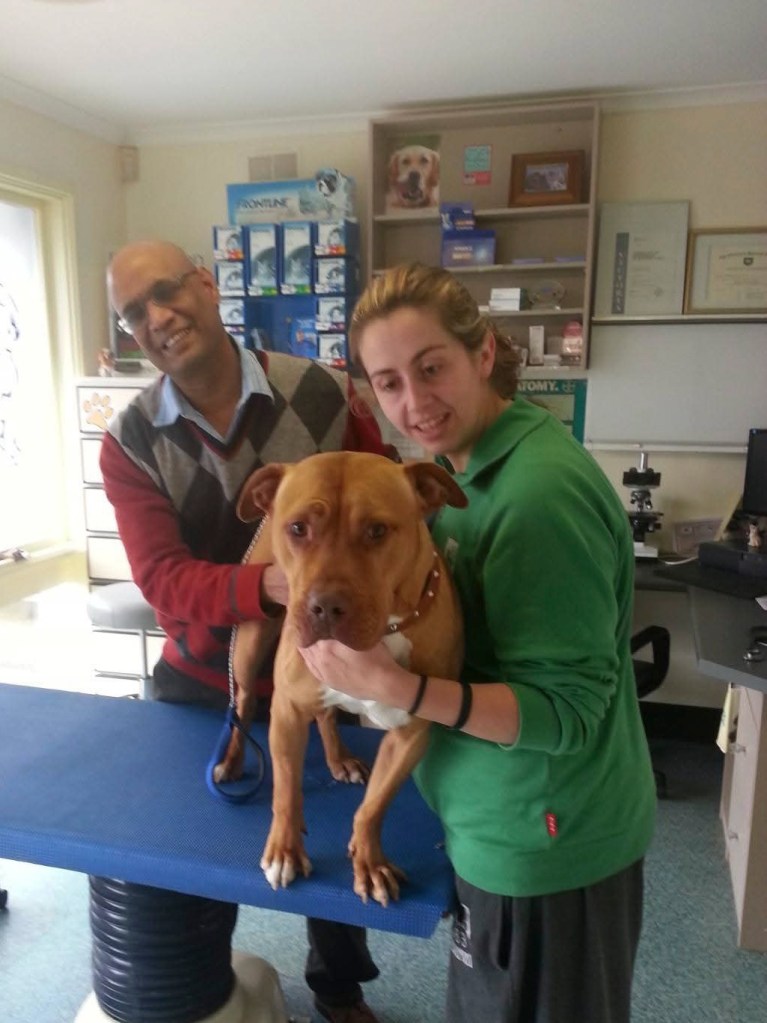
That question brought Rocket into my life.
Arthur was about twenty-five, more than six feet tall, with an olive complexion and a youthful, almost teenage face. Something open and friendly about him.
One day he arrived at my clinic in considerable distress.
“The council has seized my dog, Rocket. They say he’s a pit bull terrier. Can you do a DNA test?”
I hesitated.
I had never met Arthur before or treated Rocket. More importantly, although I knew that canine DNA testing was available, I had never collected a sample for breed identification.
Arthur noticed my uncertainty and began showing me photographs.
“The council caught him after he got out with our little Jack Russell. They’ve had him for a month.”
Then he showed me another photograph.
Rocket was playing with his two-year-old child.
“My wife is pregnant with our second baby,” Arthur said. “If Rocket were dangerous, would I keep him at home with my family?”
He showed me photograph after photograph.
Whatever the law might eventually decide about Rocket, there was no mistaking Arthur’s affection for him. He had already appealed the council’s decision and engaged a lawyer. By then, he had spent about three thousand dollars.
Arthur was a factory worker. He had a young child and a pregnant wife. Three thousand dollars was no small sum for him, and there was no guarantee his efforts would save Rocket.
After the child’s death, public feeling against pit bulls was intense. Even the name itself seemed enough to provoke fear and anger.
Still, I agreed to help.
I contacted a laboratory. They told me they could perform a DNA test if I sent them a blood sample. The results would take about three weeks.
The following week, Arthur drove my assistant and me to the council dog pound.
Entering the pound felt strangely like entering a prison.
Uniformed council officers stood behind the reception desk. Several people waited ahead of us. After about half an hour, they escorted us inside.
Rows of metal cages stretched before us, each holding a single dog. They looked uncomfortably like prison cells.
Most of the dogs were strays waiting for their owners to reclaim them. Some would be adopted. Others, particularly those considered unsuitable for rehoming, might eventually be euthanised.
Two dogs were being held separately as dangerous animals.
One was Rocket.
He was three years old, reddish-brown, broad-headed and muscular. He certainly looked imposing.
I approached him cautiously and watched his eyes and body language for signs of aggression.
There were none.
I reached out and touched his head.
Rocket began licking me.
Within minutes, I was stroking him comfortably. I drew blood from a vein in his front leg without difficulty.
I asked the pound attendants how he had behaved during his month in confinement.
“Very friendly,” they told me.
Examining him closely, I also felt that Rocket was clearly a crossbred dog.
Arthur had come with us, but the officers would not allow him inside Rocket’s enclosure. They also wouldn’t let him properly embrace or handle his dog. So, Arthur pushed his fingers through the bars.
Rocket moved towards him.
Arthur stroked him through the cage, tears filling his eyes.
For a moment, they reminded me of a prisoner and a relative trying to touch each other through prison bars.
That image stayed with me.
Rocket had already spent a month in confinement. To make matters worse, Arthur had to pay for his food and accommodation for every day he stayed there.
Three weeks later, the DNA result arrived.
I was surprised.
Only about twelve per cent of Rocket’s genetic profile showed American Pit Bull ancestry. The remainder came from several other breeds.
Put simply, somewhere in Rocket’s ancestry—perhaps around the level of a grandparent—there had been a pit bull.
Genetically, Rocket was a crossbreed.
I wrote a letter stating the result, but the council had obtained another veterinary opinion. That veterinarian examined Rocket’s physical characteristics—his head, body and general appearance—and concluded that he was of the pit bull type.
So, we now had two different ways of defining the same dog.
His DNA said one thing.
His appearance said another.
Arthur then sought the opinion of an experienced dog-show judge. His report was detailed, supported by photographs and measurements of Rocket’s body. He too concluded that Rocket was a crossbreed.
The dispute eventually reached the Victorian tribunal.
The tribunal hearing lasted about four hours.
The council had a lawyer. The veterinarian who had classified Rocket as a pit bull gave evidence, as did a council officer. The dog-show judge also appeared.
Arthur did not have a conventional legal team. A young woman presented his case, assisted by two women with doctorates in sociology. They had volunteered their time because they believed Rocket had been treated unfairly.
I attended expecting that the DNA evidence would be important.
I was wrong.
The crucial problem soon became apparent.
The legislation identified restricted dogs primarily through prescribed physical characteristics. DNA testing was not part of the legal test as I had expected.
My evidence was therefore rejected early on.
I remained for the rest of the hearing as an observer.
The council’s veterinary report became particularly important because it classified Rocket according to his appearance. During cross-examination, we challenged some assumptions in that assessment. To me, the dog-show judge’s detailed evidence appeared persuasive.
But the tribunal had to apply the law as it stood.
After four hours, the decision came.
Rocket was to be destroyed, and Arthur was given one month to appeal.
I was deeply disappointed.
Yet as I left the tribunal, another thought stayed with me.
For four hours, more than ten people had argued over the life of one dog. Lawyers, experts, council officers and volunteers had gathered to examine evidence and debate whether Rocket should live or die.
There was something remarkable in that.
Ultimately, Rocket was returned to Arthur after the appeal process, bringing a positive conclusion to the tragedy. However, Rocket had already imparted a lesson that veterinary textbooks never could.
DNA could describe his ancestry, but his appearance could determine his legal classification.
Those who knew him could describe his behaviour, but the law could decide his fate.
Sometimes a small but troubling distance exists between what the law requires and what we instinctively recognise as justice.


பின்னூட்டமொன்றை இடுக