As part of our journey, we travelled about 70 kilometres from Baku to Gobustan to see the extraordinary places where methane gas rises through mud pools. Mud volcanoes of this kind are rare in the world, and Azerbaijan is said to contain a large proportion of the world’s mud volcanoes.
How could we possibly leave such a place out of our itinerary?
The landscape along the Caspian Sea through which we travelled was dry and almost desert-like. Here and there, oil pumps dotted the landscape, reminding me of the counterweighted well-poles we once saw beside garden wells in our villages. The Caspian wind, mixed with the heat, whistled around us throughout the journey.
I could not help wondering: “Does oil always seem to be found in deserts?”
A Landscape from Another Planet
When we reached Gobustan, we saw numerous mounds of black mud. With hardly any green vegetation and dark earth stretching around us, the landscape looked as though it belonged to another planet.
When we climbed onto these muddy mounds, bubbles of various sizes appeared on the surface as gas continuously rose from below, bursting with soft popping sounds. In one pit, someone had ignited the gas, and flames continued to burn.
These mud bubbles form as gases rise from beneath the earth. I touched the mud with my fingers and, to my surprise, it felt cold.
“There are about 350 mud volcanoes in this region,” our guide told us.
I also heard that some people believe this mud is beneficial for health and beauty treatments and take it away in bottles to apply to their faces and hands. However, because Australia has strict regulations on importing soil and other natural materials, none of our group tried to take any home.
I have not independently verified the precise historical evidence for this account, so I record it here simply as information our guide gave us.
Messages Written in Stone by Early Humans
Near this area are sites where prehistoric humans once lived, together with thousands of images carved into the rocks. The Gobustan Rock Art Cultural Landscape is protected as a UNESCO World Heritage Site.
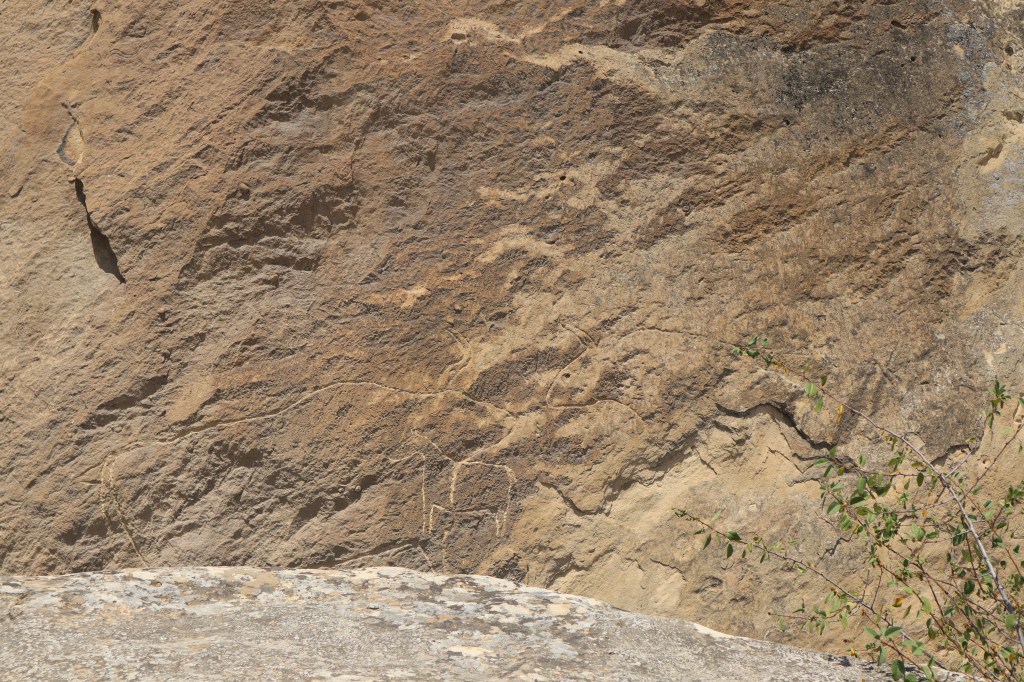
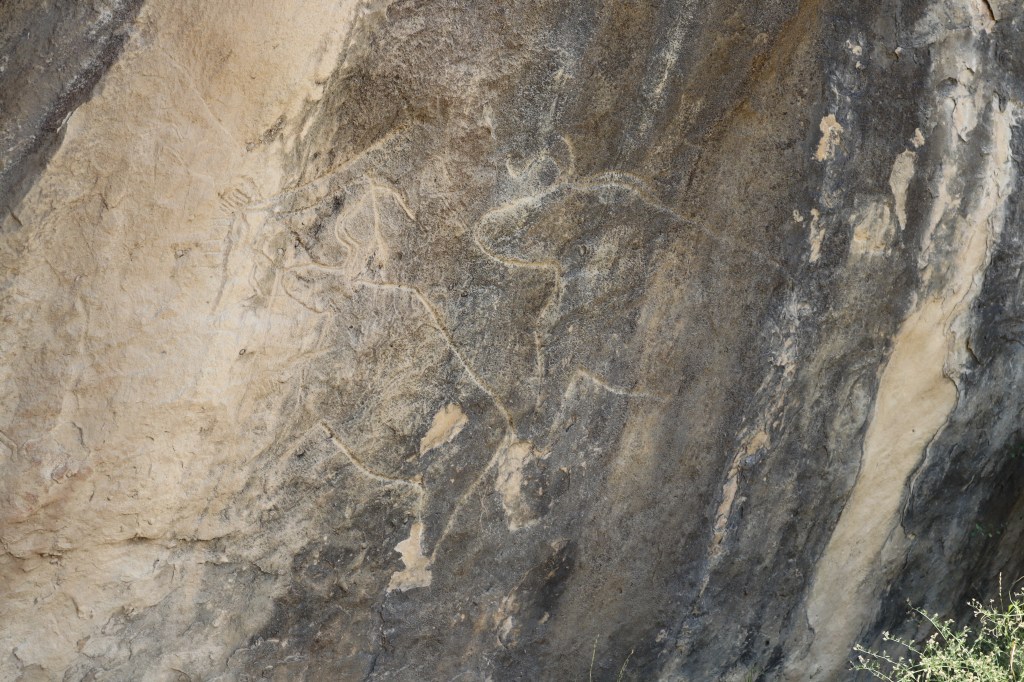
During an earlier visit to Madhya Pradesh in India, I saw many prehistoric paintings made with pigments on rock surfaces. What I saw at Gobustan, however, was different. These were not painted with colours. Instead, they had been deeply carved into the rock with stones or other sharp implements.
Among them were hunting scenes, animals, human figures and boats. Looking at them, I did not feel they had been created merely for decoration. Rather, they seemed like an ancient noticeboard on which people had left messages or symbols for others.
Such rock carvings are known in English as petroglyphs.
Petroglyphs can be found in many parts of the world, including Australia and Iran, and their ages vary considerably from place to place. Gobustan alone contains more than 6,000 rock carvings belonging to different periods.
In this region, some rocks have fractured and collapsed because of natural changes and seismic activity. Others are unstable, and for safety reasons, tourists are not permitted to enter certain areas.
We could also see small hollows carved into the rocks, apparently used to collect rainwater, as well as pits believed to have been used for cooking. In this dry land where water was scarce, these remains bear witness to the ingenuity with which prehistoric people met their basic needs and survived.
Yanar Dag — The Burning Mountain
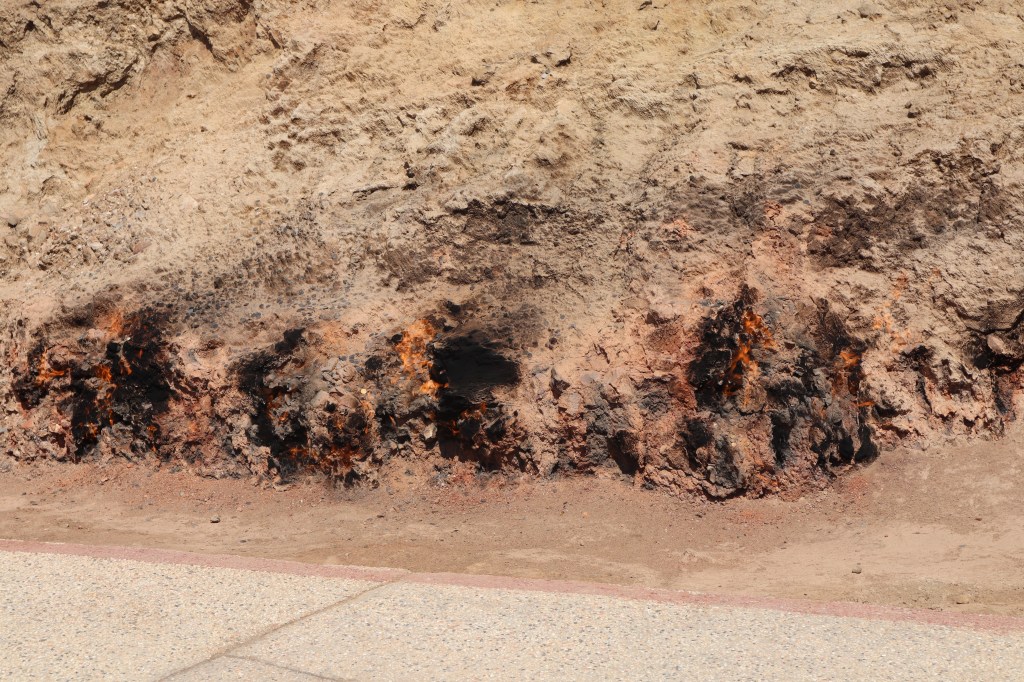
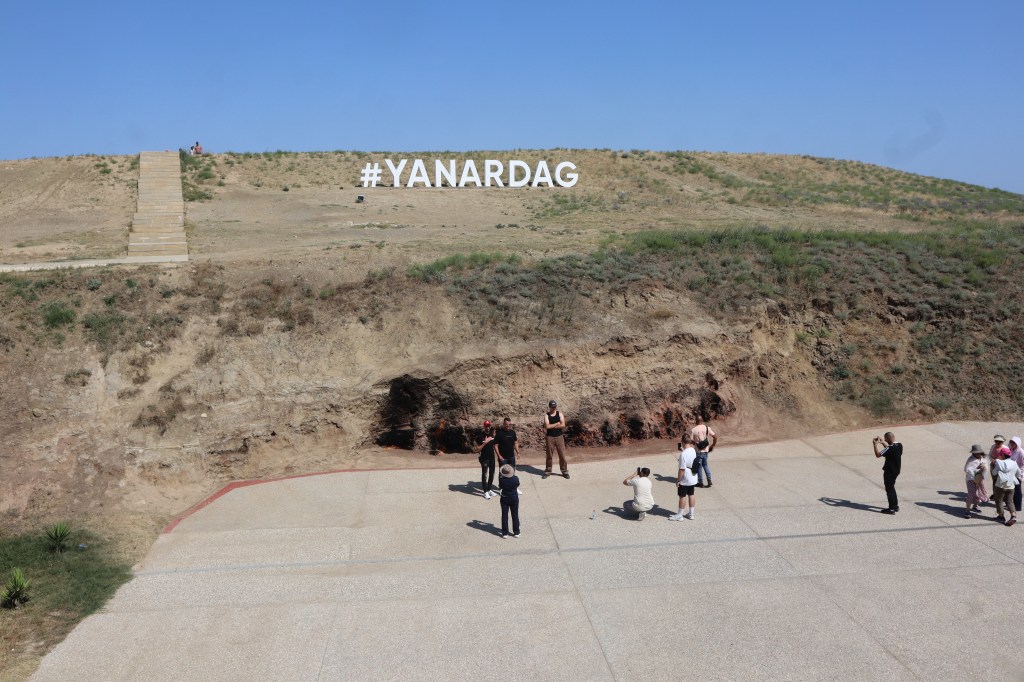
Yanar Dag, near Baku, is another remarkable natural phenomenon. On part of the hillside, natural gas escaping from beneath the ground burns continuously.
Although references to naturally occurring fires in this region go back many centuries, insufficient historical evidence exists to state with certainty that the fire at Yanar Dag has been “burning continuously for 4,000 years.” Nevertheless, it remains an important symbol of Azerbaijan’s natural-gas wealth and its ancient traditions associated with fire.
Azerbaijan also has a long historical connection with Zoroastrian traditions, in which fire represents purity.
Although most Azerbaijanis today are Muslim, pre-Islamic Persian and Zoroastrian cultural traditions are also part of the country’s historical heritage. In particular, Novruz Bayram, celebrating the arrival of spring, is observed nationally, and fire plays an important role in its celebrations.
Until this journey, I had associated Zoroastrianism’s history mainly with Iran. Visiting Azerbaijan made me realise how deeply its influence had also extended into this part of the Caspian region.
Zoroaster — An Ancient Thinker
Let us now turn briefly to Zoroaster, or Zarathustra, the founder of Zoroastrianism.
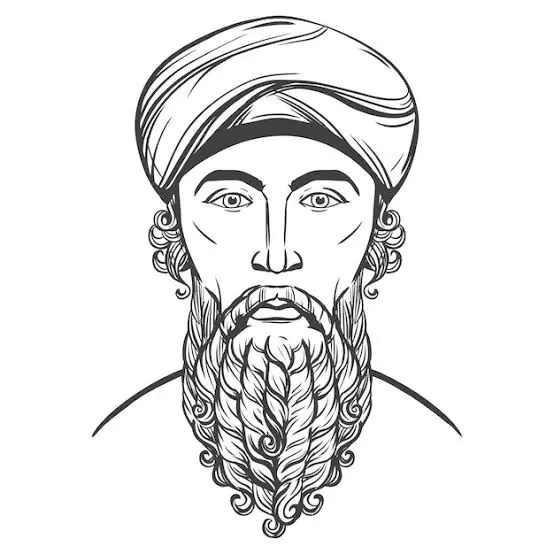
No one is certain when Zoroaster lived. Some traditions place him in the sixth century BCE, while many modern scholars suggest a considerably earlier period. His birthplace is equally uncertain, although the prevailing view is that he probably lived somewhere in the eastern regions of the ancient Iranian world.
Many stories about his life were written much later. Legends tell of attempts to kill him as a child: that he was abandoned among wolves, placed beneath the hooves of cattle and horses, and even survived fire.
These may be stories through which later generations transformed a historical individual into a sage and prophet.
According to Zoroastrian tradition, at the age of thirty he experienced a divine revelation. Thereafter, he began teaching a faith centred on Ahura Mazda, the supreme divine wisdom.
It is said that the religious authorities of his time, who valued rituals and animal sacrifices, opposed his teachings. At first, he attracted little support. Zoroastrian tradition holds that his teachings began to spread only after he gained a king’s patronage.
Later traditions also claim that Zoroaster was killed by a religious opponent at the age of seventy-seven, although this cannot be regarded as firmly established historical fact.
Good Thoughts, Good Words, Good Deeds
In Zoroastrian thought, Ahura Mazda is regarded as the supreme deity. Human existence is understood as a struggle between good and evil, and people are free to choose which path they follow.
The essence of this philosophy can be expressed in three simple phrases:
Good Thoughts — Good Words — Good Deeds.
Zoroaster did not teach people to withdraw from life. On the contrary, he emphasised living fully in the world while acting with righteousness.
For Zoroastrians, fire is not a god itself. Rather, it symbolises purity, light and truth. This is why fire occupies such an important place in their worship.
The religion also teaches that human actions ultimately have consequences and that choosing goodness and living ethically constitute a higher way of life.
In later centuries, Zoroastrianism became highly influential under several Persian empires. During the Sasanian Empire in particular, it became a major state-supported religion.
After the Arab conquest of Persia in the seventh century, Islam gradually spread, while Zoroastrians’ social and political position declined over time. Conversion, taxation, social pressures and other factors contributed to the reduction of the Zoroastrian population.
Some Zoroastrians later migrated to India’s western coast. Their descendants are today known as the Parsis. Zoroastrian communities now live not only in India and Iran but also in countries including the United States, Canada and Britain. Their declining population, driven by factors such as low birth rates and the tradition of marrying within the community, has become a major concern.
Ganesha in Baku’s Fire Temple
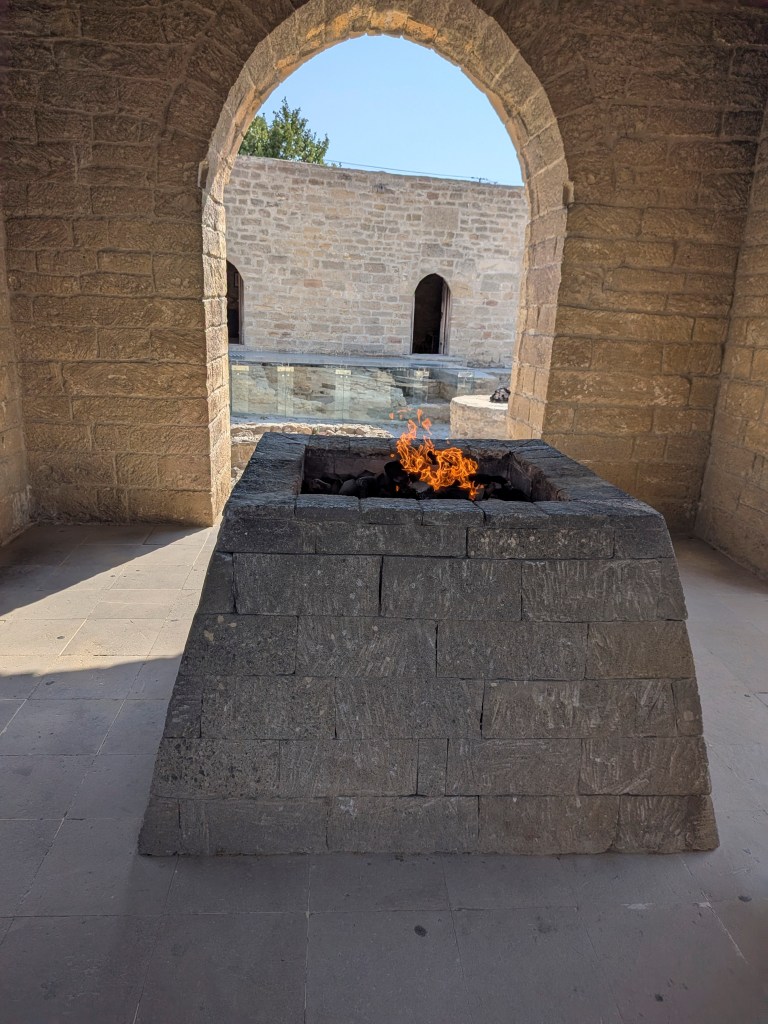
When we visited the Atashgah Fire Temple, outside Baku, another surprise awaited me.
Within the fortress-like complex, I was astonished to see Hindu religious symbols and inscriptions written in Sanskrit and other Indian languages.
“How did these come to be here?” I wondered.
Indian merchants had travelled to this region along routes across the Caspian and through the old overland trading networks. The inscriptions show they stayed and worshipped here. Historical research shows that the complex was associated not only with Zoroastrians but also with Hindu and Sikh merchants and pilgrims.
Natural gas once fed the flames at this site. Later, as oil and natural gas were extensively extracted around Baku, the natural gas flow diminished and the flame went out. The fire seen there today is sustained by gas supplied through pipes.
Our guide told us, “The site was restored in the 1960s by the Soviet Government because Indian Prime Minister Indira Gandhi was expected to visit.”
Inside the rooms, figures depict how ascetics and pilgrims of earlier times may have lived. Looking at them, I was strongly reminded of Indian ascetics.
Many famous travellers, including the French writer Alexandre Dumas, wrote about this fire temple.
Today, the site is preserved as a museum and historical monument.
In a single day, I saw gas bubbles rising through the black mud of Gobustan, the natural flames of Yanar Dag, the messages left by prehistoric humans on the rocks, and the traces of India I discovered at Atashgah.
After seeing all this, Azerbaijan no longer appeared to me merely as a country rich in oil. Instead, it seemed like a land that preserves gas beneath its soil, human history in its rocks, and the memory of an ancient religion in its flames.


மறுமொழியொன்றை இடுங்கள்