WordPress Translation and Edited by Noel Nadesan
Azerbaijan, Armenia, and Georgia are three small nations located along the Caucasus mountain range, which bridges Asia and Europe. Historically, powerful neighbouring empires such as Persia, the Ottoman Empire, and Russia governed them. In the past century, they became part of the Soviet Union. The region’s position along the historic Silk Road, which connects the East and West, has consistently made it strategically significant to powerful empires.
These countries gained independence following the Soviet Union’s collapse in 1991.
Azerbaijan was under Turkish and Persian influence for many centuries. Although the majority of the population is Shia Muslim, the state is secular.
Our journey began in Baku, Azerbaijan’s capital.
Baku is located on the coast of the Caspian Sea. Unlike other bodies of water, the Caspian is an inland sea entirely bordered by Russia, Iran, Kazakhstan, Turkmenistan, and Azerbaijan. It is also the world’s largest saltwater lake.
The oil and gas reserves under the Caspian Sea have driven Azerbaijan’s economic growth. Baku features many new buildings with impressive modern architecture, and European design influences are visible across much of the city. Like my admiration for Qatar’s grand structures, I was also fascinated by the buildings along the Caspian Seafront here.
We reached Baku two days before our scheduled tour, mainly to let our bodies acclimate to the time change from Melbourne.
When we arrived, the summer temperature was approximately 32°C.
Driving into the city from the airport, I found Baku very clean, with wide streets. But the relatively light foot traffic caught my attention.
Since we arrived two days early, I planned to visit a few sites outside our scheduled tour. I had already heard of Baku’s Carpet Museum and didn’t want to miss it.
In Azerbaijan, carpet weaving is more than just an industry; it is an integral part of family life and cultural tradition.
I learned that one tradition involved letting newborns crawl on a freshly woven carpet. Additionally, it was customary to give young girls a weaving loom as they grew older. For many generations, carpet weaving was deeply connected to women’s lives. Family and community gatherings often took place on carpeted floors.
Entering the museum, my view of carpets changed from just practical items to culturally significant artifacts. I saw how they embedded society’s art, beliefs, lifestyle, and history, passing these elements across generations. Silk rugs, notably, were crafted mainly for decoration.
Livestock herding has been practiced for thousands of years in the southeastern Caucasus foothills, where sheep’s wool is spun into yarn and eventually woven into beautiful carpets. Flocks have grazed here since ancient times, thanks to good pastures and a suitable climate. Additionally, they raise high-quality wool sheep breeds here.
After shearing, they clean, process, and spin the wool into yarn. They then dye this yarn using natural colours extracted from plants and minerals. I was surprised to discover that dyes can also be made from common materials like onion skins.
Men helped prepare and process the yarn, but women’s role in weaving was essential.
The museum displayed carpets from ancient times to the modern era. Differences in design and colour were evident across carpets from different regions. Each region had developed its own artistic language.
Later carpets also depicted humans, events, and stories, woven like paintings. Looking at them, I understood that a carpet is not merely something spread on the floor—it is a manuscript that carries a society’s history to the next generation.
Azerbaijan’s traditional carpet-weaving art has been recognised by UNESCO as an Intangible Cultural Heritage of Humanity.
The museum building itself was beautifully designed to resemble a rolled-up carpet.
I spent three hours examining those carpets. Museums like this typically bored my wife, Shyamala, a bit. However, when she pointed out details I had overlooked, I realised she had also become engrossed in that world of carpets.
In the evening, we visited the Caspian Seafront. The wind was so fierce it seemed likely to knock us down, which made me realise why Baku has been known as “the City of Wind” for a long time.
Near the seafront, a shopping plaza was designed like a lotus flower. I believe it was the most beautiful shopping complex I’ve ever seen. We didn’t find anything to buy—most items were high-end fashion—so we just looked around and then left.
That evening, we went to a traditional Azerbaijani restaurant, where they served tea with lemon slices.
Qutab, a popular Azerbaijani dish, consists of meat, pumpkin, greens, or cheese wrapped in thin dough, then folded and grilled. It is a fundamental part of Azerbaijan’s culinary heritage.
The following evening, we had arranged a city tour with a young guide named Emilia.
Many people had told us, “If you want to see Baku’s true beauty, you must see it at night.”
They also said the three tall Flame Towers in the city centre look like blazing flames when lit up at night. We thought we’d see it for ourselves.
Long before the arrival of Islam, this region was already influenced by Zoroastrianism, where fire holds significant symbolic meaning. In certain areas of Azerbaijan, natural gas escaping from the ground has caused fires to burn nonstop, further cementing fire as a historic symbol of the country.
The birthplace of Zoroaster is still uncertain, with theories suggesting Iran, Central Asia, or parts of present-day Afghanistan. Nonetheless, it is clear that Zoroastrianism had a major impact on the ancient Persian realm, including Azerbaijan.
As Islam expanded across the region from the 7th century onwards, Zoroastrianism’s political and social influence waned. Nevertheless, its cultural traditions persisted to some extent. Today, remnants of its legacy are visible in Azerbaijan’s fire-related symbols.
We then went to Martyrs’ Lane.
In January 1990, Soviet forces entered Baku, resulting in the deaths of many civilians. This incident is known in Azerbaijan as “Black January.” While Western media celebrated Soviet leader Mikhail Gorbachev as a reformer, many Azerbaijanis hold a very different view of him.
This area also hosts memorials dedicated to those who perished in the Nagorno-Karabakh conflicts and subsequent wars. Adjacent to them is a memorial and mosque honouring Turkish soldiers — specifically, Ottoman soldiers who lost their lives in the 1918 Battle of Baku at the end of World War I.
One photograph among those of the deceased caught my attention — it featured a young man and a woman in wedding attire.
I inquired with the guide, and she explained they were a young couple about to marry. After the young man was killed during that day’s violence, the woman also died, and their memories are now kept together.
That story moved me deeply.
Several individuals from various countries participated in our night tour. Among them, we became especially close to a couple from Pakistan.
While discussing current Middle Eastern politics, the Pakistani husband said, “Iran could afford to be a little more peaceful.”
A lecturer from Bahrain responded, “Our country maintains a very close defence relationship with the United States. As a result, establishing friendly relations with Iran is quite challenging.”
“What happened to Islam being a religion of peace?” I thought to myself. But I said nothing.
It occurred to me that, beyond religions, political regimes, and empire rivalries, fire has been the true catalyst igniting many conflicts in this region. From the 7th century to the present, many parts of West Asia have remained a place where fire and smoke consistently emerge.
In Azerbaijan, a historical bitterness towards Russia was palpable. Similarly, the memory of centuries of Persian dominance and the political relationship with present-day Iran had generated negative feelings in some people.
The experiences of the Soviet era had not been forgotten either.
Isn’t it the same in our own country too?
History ends, but the hatreds it has sown keep sprouting in the generations that follow.
In Azerbaijan, the majority of Muslims belong to the Shia tradition; Sunni Muslims are also present in significant numbers. Jews and Christians live here too. The government emphasises secularism.
Alcohol is available everywhere. Women walk the streets mostly in Western clothing. We saw no state restrictions on dress.
Something our guide Emilia said made me think.
“My grandmother is looking for a husband for me. I keep putting off the marriage. My grandmother has a diary. She’s noted down in it everything she’s given as gifts at other people’s weddings over the years. Her main goal is to recoup that money at my wedding. Beyond that, she’s not particularly concerned about my life!”
She said it with a laugh.
Then — “It’s not just my grandmother; all the old women in this country are wandering around with a diary like that!” — and she pulled her jeans down slightly to show off a wide belly.
Shyamala whispered in my ear, “How is this girl’s way of talking?”
“We’re in an age where individual freedom is breaking through social constraints,” I said.
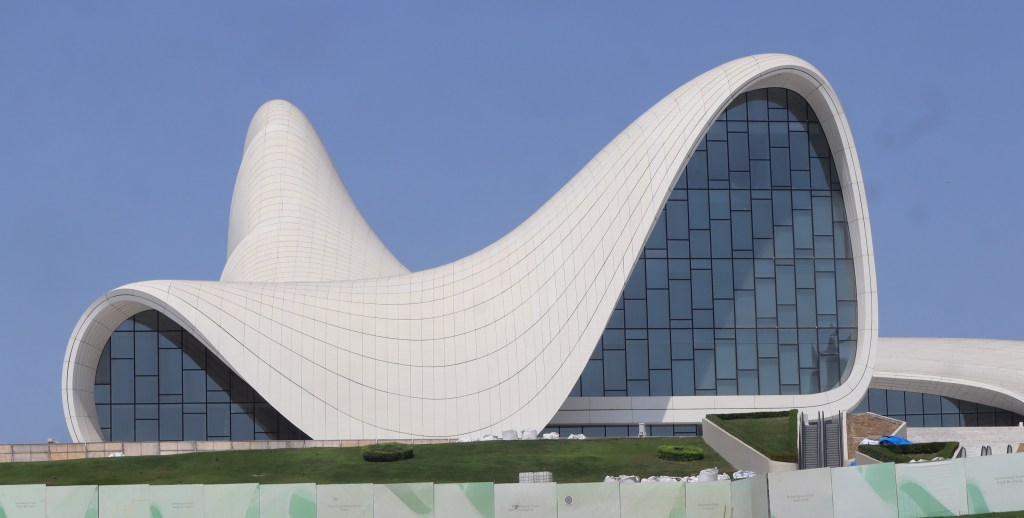
The last place we visited that evening was the Heydar Aliyev Centre, designed by the world-renowned Iraqi-born architect Zaha Hadid.
It is considered one of the most important works of modern world architecture.
A defining characteristic of Zaha Hadid’s buildings is the avoidance of straight lines and sharp corners, replaced by curves and continuous surfaces. Here too, the building rises from the ground, curves, and becomes the roof — as if evoking the waves of the Caspian Sea.
But Emilia had her own explanation.
“This was designed after seeing Marilyn Monroe’s skirt billowing in the wind!” she said.
She was being playful, of course.
But it was impossible not to appreciate the mischief and self-confidence of that twenty-two-year-old woman.
The Soviet Union’s economic policies ultimately failed and fell apart. But the traces of the changes that Soviet system brought about — particularly in education, employment, and public health for women — can be seen when visiting its former republics. The Soviet era played a major role in bringing women in Muslim-majority societies into public education and professions in large numbers.
In Azerbaijan too, the Soviet era’s contribution was significant — shifting from a social structure where women were confined to weaving carpets at home generation after generation, to one that brought women into schools, universities, workplaces, and public life.
In Baku’s Carpet Museum, I had seen carpets woven by the fingers of women of old.
And on those same streets of Baku at night, I had seen Emilia — in jeans, laughing as she poked fun at her grandmother’s wedding diary.
Between those two images, I felt, lies a part of the social history of Azerbaijan’s last century.


பின்னூட்டமொன்றை இடுக