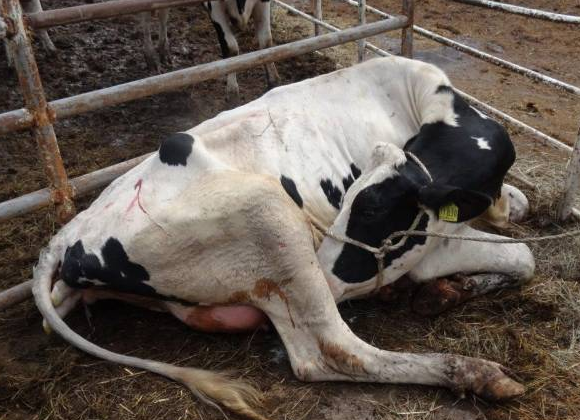
Horsham, a rural town in Western Victoria, is famous for its cattle industry, especially the breeding of Hereford beef cattle. These cattle are large, weighing between 800 and 1000 kilograms, which makes them hard to handle. When a Hereford cow has difficulty calving, she needs a caesarean section—a complex procedure even for veterinarians during the day. Conducting such surgery at night, under car lights and with limited help, is even more challenging. I remember being called to perform one of these procedures many years ago as a locum veterinarian. To this day, I recall not just the operation but also the stories two Australian farmers shared with me that night.
While working as a locum near Horsham, I got a phone message from a farm about a Hereford cow struggling to calve.
The dairy farm was approximately 15 km from the veterinary clinic where I was working as a locum, as I did not have a permanent position at the time. I mainly served in Victoria County, filling in for veterinarians on holiday.
Temporary or locum work in remote areas of Australia sustained our newly migrated Sri Lankan family and offered essential experience and training for my future in Australia.
I reached the farm around 6:00 p.m., just as darkness fell over the lone farmhouse in the expansive grassland. Two elderly men living there led me to the paddock, where a red Hereford cow with a white head was visibly distressed. The cow appeared pitiful, groaning loudly, frequently bellowing, and rocking her body like a seesaw.
Since it was quite dark, I needed a light to work effectively. James, who lived on the farm, quickly provided light using his car battery. I promptly took action: sedating the cow and administering an epidural into her spine, which gradually caused her hindquarters to lose movement. After lubricating my hand and inserting it into her vulva, I found the calf was dead, with its head protruding while the rest of its body remained inside the uterus. The neck of the dead calf was bloated, preventing me from pulling it out the normal way. I concluded that a caesarean section was the only option to help the poor creature.
I laid dried hay on the ground and prepared to perform the operation to remove the dead calf. Bending my knees and cutting through the thick skin of the Hereford cow was challenging. The process was lengthy and took several hours.
As James and Jack observed my surgical procedure, they reminisced about their past lives. James, a former Australian Army soldier stationed in Singapore during World War II, was captured by Japanese forces. He recounted the painful experiences he endured during captivity, including the hardship of eating only plain rice, despite having grown up as the son of a beef farm owner, where meat was a staple. The lack of proper nourishment caused him to lose 42 kg, leaving him frail and emaciated, skin and bones.
“We were not treated with dignity as captured prisoners of war; we were tortured and humiliated. Instead of allowing us to sleep, they forced us to stand throughout the night. As if the torture of keeping us awake was not enough, we were beaten, attacked and kicked in the genitals. If we raised any objection to these atrocities, we were sentenced to death,” he said. Worse still, it was shocking and frightening to hear about his experience of catching feral rats in drains and eating them out of sheer hunger. He said, jokingly, that he was happier to see rats than jabs.
As James recounted the tortures experienced during the Second World War, I was reminded of the atrocities and brutalities inflicted on detainees in my homeland, Sri Lanka. When I mentioned my Sri Lankan background, I discovered he was also aware of the situation there. I inquired about his family, and he explained that the severe torture by the Japanese had destroyed his libido, forcing him to remain single because he could no longer sustain a marital life. His brother Jack also chose not to pursue a family life.
He explained that the cattle farm was a family-owned business, and he considered the cattle as family. They reached out to me because they couldn’t bear to see the cow suffering during calving. Jack and James quickly assisted me with the cow’s medical needs, showing their strong commitment to their cattle. James, who had previously endured human cruelty, found it hard to accept the suffering of an innocent animal.
I finished my surgery, removed the dead calf and sutured the cow’s skin back around midnight, with the satisfaction of saving a four-legged animal, though I knew that it would soon be sent to slaughter for human consumption.
It was nearly midnight when I departed from the farm. That day, I learned about veterinary medicine and uncovered a part of Australian history that will be valuable as I start my life as a new citizen.


மறுமொழியொன்றை இடுங்கள்