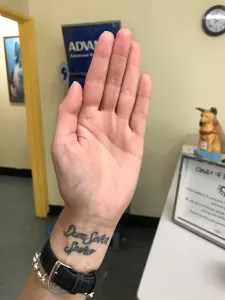
As Michelle reached out to give me her credit card, I observed words tattooed on the inside of her forearm. They initially appeared to be in English, but I couldn’t read them clearly.
I asked, “What does it say?” because I couldn’t decipher the words.
Still holding her hand, she looked at me, while my nurse, her parents, and even the little brown Chihuahua in her father’s arms appeared to watch my reaction.
Everyone except the Chihuahua smiled. Maybe the little dog smiled as well—I wasn’t sure.
I’ve never seen this tattoo before,” I said. “What does it mean?”
She responded with genuine surprise, asking, “I thought you knew Latin.”
“I already struggled enough with English,” I laughed. “How could I possibly know Latin?”
“It means ‘I will live until my last breath.’”
Her smile illuminated the room as she spoke.
“Really?”
“I had it tattooed just last week.”
No words occurred to me. Not only had Latin abandoned me, but my English also slipped away.
What could I say to comfort her?
Did I meet Michelle only yesterday? No, I have known her for nearly fifteen years. Throughout that time, she has openly shared every part of her life with me, either directly or through my nurses. The words tattooed on her arm felt more valuable than any jewellery. Unlike many who get tattoos for beauty, identity, or to honour a loved one, Michelle selected these words herself.
At forty-five, having endured so much, she tattooed those words as a daily reminder—to empower herself, silently repeat them each morning, and find courage within.
With that in mind, I finally found the words to say.
“May I take a photo of your tattoo?”
She chuckled, winked with her striking blue eyes, and lifted her arm.
I picked up my phone from the desk and snapped a photo. In the first shot, her father was visible in the background. I politely asked him to move aside before taking a second photo of her arm.
Fifteen years ago, I first met Michelle, who was married and around thirty. She was employed in the sales department at Coles, a major Australian supermarket chain. She often brought her two Labrador Retrievers to my clinic.
She was stunning—tall with large blue eyes, golden hair, a finely sculpted nose, and full lips often curved into a smile. Her beauty was so striking that it could make even other beautiful women feel envious.
Her black Labrador eventually became unable to walk because of age and illness, leading me to euthanise him. That was the only day I ever saw Michelle without her usual smile; her face appeared as dry as a summer well.
She developed a strong bond with her yellow Labrador, promptly bringing him to see me if he missed even a single meal.
One day, she arrived with tears in her eyes.
“What seems to be the problem?” I asked casually, assuming it was minor.
Her answer struck me like a blow.
“My husband has left me.”
She broke down in tears.
What comfort could I offer?
“I’m so sorry to hear that,” I said quietly.
Feeling it would be inappropriate to stay any longer, I retreated to my consulting room.
My nurse, Sharron, had a remarkable talent. People instinctively trusted her, and she effortlessly revealed their concealed feelings.
Later, Sharon mentioned that Michelle couldn’t have children due to a uterine condition, and her husband had left her because of it.
“Now this dog is all I have,” Michelle had told her.
She also noted that the Labrador had multiple lumps beneath its skin and requested that they be removed.
Psychologically, this makes sense because individuals often transfer the love they can’t give to children onto their pets.
The lumps were just benign fatty tumours, which are very common in aging Labradors. I mentioned that removing them wouldn’t stop new lumps from developing elsewhere in a few months.
Michelle remained firm.
She wanted them removed.
Although those lumps had been present for years without causing her concern, she now fixated entirely on the dog, almost like a child clutching a Favorite toy for reassurance. Eventually, we carried out the surgery.
Even after her appointments, Michelle often remained at the clinic for a few minutes, engaging in chats and sharing laughs with us. My nurses became very fond of her. When conversations turned to topics women preferred to discuss in private, I would quietly excuse myself.
A few years afterward, the yellow Labrador suffered from severe arthritis. We cared for him over several years until he also passed away.
Michelle left our clinic without her dogs, and we didn’t hear from her for several years.
One day Sharon came to me.
“Michelle has cancer,” she said. “She’s had to stop working.”
I was stunned.
At such a young age?
Had life not been cruel enough already—dealing with infertility, losing her husband because of it—and now confronting cancer?
Michelle’s parents had migrated to Australia from Croatia. As their only child, she had no siblings. Her ageing parents were now her only family.
On a spring morning in Melbourne, gentle sunlight poured through the clinic entrance as I opened the front door.
Seeing unfamiliar faces, I welcomed them inside.
As my eyes adapted to the light, I struggled to believe what I saw.
Michelle stood there, holding a small Chihuahua in one hand and a walking stick in the other, with her parents quietly standing behind her.
It was Michelle, but she was visibly changed.
The beautiful woman I once knew looked like a masterpiece that its artist had angrily crumpled and tossed aside.
Beauty, youth, and health are fleeting gifts that do not last forever. Unlike possessions passed down by our parents, they are as transient as water scooped from a flowing river.
However, one thing remained the same.
Her smile.
She walked into our small clinic, radiating warmth, and explained that her Chihuahua was scratching her arms, asking if we could trim its nails.
Her parents, now in their seventies, always accompanied her. At an age when others might be caring for them, they were instead caring for their daughter and her dog.
She told us openly about her ongoing cancer treatment. We asked no questions. She hid nothing.
Five years have now passed.
Sometimes she arrives with her walking stick.
“I’m feeling a bit better now,” she says. “However, I can’t drive anymore. My parents drive me to shop and wherever else I need to go. This small dog is always by my side.”
During her most recent visit, she looked brighter than I had seen her for years.
“You look cheerful today,” I said.
She smiled beautifully, raised her tattooed arm, and said,
“I live every day.”
In that moment, Michelle revealed to me the core of existentialism: each person is responsible for living by their own decisions, no matter the situation.
After she left, I turned to my nurse.
“We don’t need to feel sorry for Michelle,” I said.
“What she needs from us is encouragement.”
Michelle had already decided how she would live—one day at a time, until her very last breath.


மறுமொழியொன்றை இடுங்கள்