By Nadesan
Having spent forty years as a veterinarian and now being retired, I remain amazed by the strong desire to live I see in animals. This is evident in their behaviour, whether in the animals I treated or in those that shared my home.
In my memoir, *Traces of My Life as a veterinarian*, I describe numerous pets and their owners.
When cats fall ill, they typically seek a quiet, secluded spot to recuperate on their own. In contrast, dogs tend to behave differently, with most instinctively seeking proximity to humans.
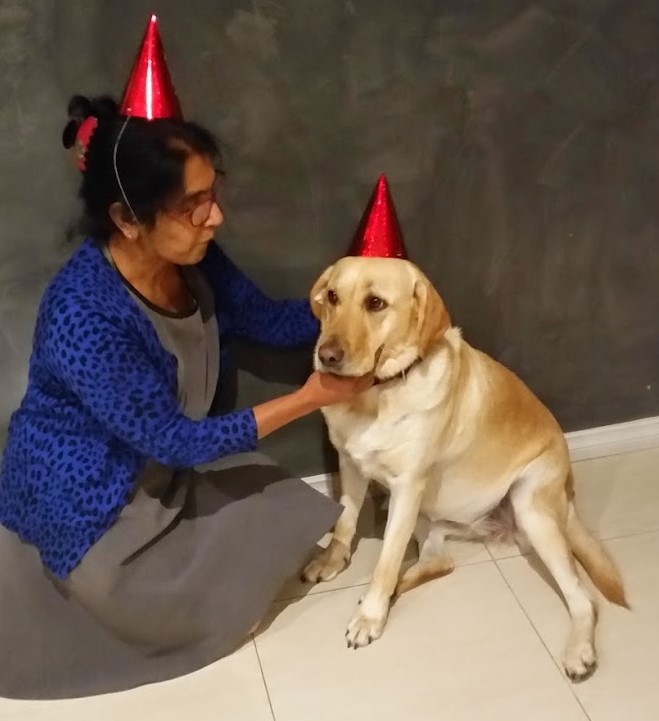
Today, I want to share about Sindy, the dog who lived with us. During the COVID lockdowns, when we were confined at home, she was more than just a constant presence, roaming around with us. She also served as our personal fitness trainer. With gyms closed and fitness instructors out of work, Sindy helped keep us moving.
Every evening, she motivated us to walk three kilometres, regardless of winter cold, wind, rain, or even the pandemic. For me, with diabetes, and my wife, who has an artificial hip, Cindy has been like a personal doctor in her own way. After our walks, my blood sugar levels decrease, and the stiffness in my wife’s leg lessens.
Sindy is the third dog I have welcomed into my home since I moved to Australia and purchased a house.
Our first dog was Sandy, a Labrador who had spent her initial four months with another family. When that family separated and could no longer care for her, they surrendered her to the veterinary hospital where I worked. I took responsibility for her and decided to keep her original name, Sandy, to prevent any confusion.
When Sandy joined us, we were overwhelmed by the fast-paced nature of immigrant life. It felt like a piece of chewing gum stuck to a speeding car wheel. We had two teenage children, ran our own business, published Uthayam, a bilingual monthly Community magazine in Australia, and I kept writing too. Free time seemed to vanish like a black cat slipping into the darkness.
Most days, taking Sandy for walks was impossible, so I spent little time with her. She grew up in the household, almost like a curry-leaf tree that thrives unattended in a rubbish heap. Despite our busy home filled with children, relatives, and visitors, she never lacked companionship. Until her final days, she slept on the floor beside our bed, and in her old age, her snoring sounded like a tiger’s growl.
My wife sometimes notes that, unlike many parents, we didn’t spend every day watching our children grow. As life speeds by, many people look back and regret what they didn’t do. Those over sixty-five often feel they could have handled things differently. These thoughts can lead to guilt. However, we seldom take the time to consider our achievements. Just like crossing a river, once the water has flowed past, we will never see it again.
Although we regretted the ongoing work, Sandy stayed with us for fourteen years and ultimately passed away from cancer in old age.
Our children finished their education, got married, and built their own lives. What we lost with them cannot be regained—similar to a fish slipping away into the sea.
Sindy arrived at just two months old. Her father was black, and her mother was a golden Labrador. She descended from a line of hunting dogs bred for bird retrieval. By the time she became part of our family, our children had already moved out, and my wife and I had cut back on our work responsibilities. Sindy was raised as an only child.
Sindy, unlike many dogs, shows little interest in playing with others. Her main desire is to stay close to us. Her needs are simple: two meals a day, regular walks, and our company.
She has developed into a nervous dog, fearful of loud noises. She prefers women over men and is selective even among women. She avoids children and dislikes small dogs, especially those that bark too much. She only barks when someone arrives at our front door.
She tolerates birds to some degree but views cats as foes and will pursue them. However, her most annoying habit is her instinct to leap at anything airborne. Her ancestors were bred over generations to retrieve birds shot by hunters and those that fell into water, and this instinct is still strongly present in her.
Vacuum cleaners and lawn mowers scare her. Even our sneezes and coughs at night startle her awake. To protect her, I often hold back my coughs and sneezes so they stay quiet. After eight years, these habits are still the same.
One incident perfectly illustrates her fearfulness.
About four years ago, near our old house, there was a large park called Jells Park, which was almost four kilometres long and had a half-kilometre bushland area attached. I frequently walked there on narrow paths, listening to music while Sindy followed behind me. The scent of eucalyptus filled the air. It was generally a quiet, solitary spot. Sometimes, a person with a dog or a bicycle would pass by. In summer, I was careful to watch out for tiger snakes living in the area.
One drizzly winter day, a man pushed a bicycle past us, wearing a helmet and a raincoat. As he went by, he asked, “Is your dog okay?” I assured him, “Don’t worry.”
A few minutes afterwards, I looked back and realised Sindy was gone.
I spent half an hour searching frantically through the bushland. Finally, I phoned home. My wife informed me that Sindy was already there.
When I got home, Sindy greeted me at the door, wagging her tail. She had somehow travelled nearly two kilometres, crossing several busy roads. It seems she thought the strange man in the helmet and raincoat was too scary and believed home was the safest place. At that moment, she didn’t trust me to keep her safe.
Recently, after selling that house, we temporarily moved into another property while it was being renovated. Four young men volunteered to repair the roof and showed us broken tiles. Trusting that the repairs were necessary, we hired them. They also offered to paint the house.
Ultimately, they completed only about a quarter of the work they had promised. It became apparent that they lacked the required skills, and later, they brought in Burmese refugees with limited knowledge of painting. In the end, I instructed them to stop.
I wasn’t angry at them; I was instead critical of myself for hiring strangers without proper background checks.
A few days later, after returning home, I was shocked to find the back gate open. Sindy was gone.
It was obvious that someone had accessed the property. Additionally, some of the equipment left by the workers was missing. As my wife and I cursed the careless men, we started looking for Sindy.
In Australia, when lost dogs and cats are found, they are typically taken to nearby veterinary clinics. We contacted several clinics by phone to report these animals.
After nearly three hours of searching, we spoke with a woman from an Indian family nearby. She said, “Your dog arrived at your house about two hours ago, stayed at the front door for a few minutes, then left.”
I was annoyed. I imagined most Australians would have either kept the dog safe or taken her to a veterinary clinic.
After continuing our search, we finally arrived at an Australian neighbour’s house, where a small dog inside the house frequently barked at Sindy. The front yard was filled with overgrown shrubs.
There, beneath a bush, sat Sindy.
As soon as she saw us, she hurried over. After returning home, she drank plenty of water. It was obvious she had been hiding under that bush for three hours.
Although I feed her meals in the morning and evening, she knows her extra treats come from my wife, Shiamala. She often stands beside Shiamala, hoping for more food, which has led to her gaining weight. We eventually changed her to a special diet. Initially, she disliked it, but now she accepts it. When hungry, she silently appeals by rubbing her face against us.
During the pandemic, our evening walks took on greater significance due to the scarcity of people out and about. Close to our home, there’s a leash-free park where dogs can run freely. Without Sindy, I wouldn’t typically spend an hour walking outdoors on cold winter nights. Instead, I would likely be sitting in front of the television or mindlessly scrolling through social media. When my phone tells me I have walked three kilometres, whom should I thank?
Owning a dog incurs costs. Food can be expensive, travel requires arranging pet care, and their fur must be vacuumed regularly from the house. Yet the benefits far outweigh the inconveniences. During the isolation of the COVID years, the joy Cindy brought was comparable to the exhilaration of first love in one’s teenage years. Those who have never experienced it may find it hard to understand.
In many families, I have observed that marital tensions often diminish because of a pet. Couples who had ceased communicating sometimes started talking again because of their mutual affection for an animal.
The benefits go beyond just emotional health and physical activity.
Many elderly individuals prefer to stay in their own homes rather than move to nursing facilities because they want to keep their pets. Studies indicate that providing support for older adults at home can be more beneficial for society than institutional care. The COVID-19 pandemic vividly emphasised this point. In countries like England, Italy, and France, a significant number of pandemic-related deaths occurred among residents of aged-care facilities.
Research indicates that Australians without pets visit doctors approximately 11 times annually, while pet owners visit around 9 times. This suggests that having companion animals could help lower healthcare costs at the national level.
Children raised with animals are often believed to develop increased compassion and empathy. In my experience, pets encourage patience and tolerance.
For millennia, companion animals have played a vital role in human history. Long before the rise of modern religions, dogs and cats became members of human families. Dogs accompanied us during the hunting period, while cats entered our lives with the advent of agriculture and grain storage.
Just as childhood memories of friends last a lifetime, dogs and cats have been companions to humans for centuries.
We will also continue to share our future with them.


மறுமொழியொன்றை இடுங்கள்