
Although I was born in Sri Lanka, my knowledge of Buddhism was largely limited to the stories I learned as a child. It was only after migrating to Australia that reading and travel enabled me to appreciate Buddhism within its broader historical and cultural context.
Last year, I visited the ancient Buddhist stupa at Sanchi, built by Emperor Ashoka in the third century BCE. Located about forty kilometres from Bhopal in central India, Sanchi is one of the most important Buddhist monuments in the world. The Great Stupa, which houses relics associated with the Buddha, is surrounded by several smaller stupas. Its imposing dome and beautifully carved gateways attract visitors from across the globe.
The four gateways, positioned at the cardinal points, are masterpieces of early Indian sculpture. Their stone carvings depict scenes from the Buddha’s life, stories from the Jataka tales, and episodes associated with Emperor Ashoka. These narratives unfold in stone like a vast visual chronicle.
One of the sculptural panels illustrates the story of Queen Maya Devi, whose dream of a white elephant was interpreted by court astrologers as an auspicious sign foretelling the birth of an extraordinary child. Such legendary and religious narratives are vividly represented throughout the monument.
Each gateway contains a distinct collection of stories, with particular emphasis on the Buddha’s previous births. These carvings are regarded as among the earliest surviving examples of Indian sculptural art, predating the celebrated sculptures of Mamallapuram by nearly nine centuries.
Several pillars at Sanchi feature the Ashoka Chakra. Among the figures depicted in the carvings are people who appear to be foreigners. Their clothing and footwear suggest Greek origins, providing evidence of cultural interactions within the Mauryan Empire and indicating that some Greeks may have embraced Buddhism. Through these sculptures, one gains valuable insight into the political, social, and cultural world of ancient India.
Near the Great Stupa, I observed two smaller stupas dedicated to the Buddha’s chief disciples, Śāriputra and Maudgalyayana. According to Buddhist tradition, both disciples passed away before the Buddha’s Parinirvana.
What struck me was how Buddhist teachings were preserved in ancient India. For centuries, the Buddha’s teachings were transmitted orally rather than through written texts. Like the Vedic tradition, memorisation was considered the most reliable method of preserving knowledge. As a result, religious stories and historical events were often recorded visually through carvings on rocks, monuments, and temple walls.
Sri Lanka played a crucial role in preserving this heritage. During the first century BCE, monks in Anuradhapura committed the Pali Canon, or Tipitaka, to writing for the first time. Until then, the teachings had been preserved orally. Sri Lankan monks also produced important commentaries, chronicles, and scholarly works that became foundational texts for Theravada Buddhism.
The influence of these monks extended far beyond the island. While Chinese monks and scholars were instrumental in spreading Mahayana Buddhism throughout East Asia, monks from Anuradhapura helped establish and strengthen Theravada Buddhism across Southeast Asia, particularly in Myanmar, Thailand, Laos, and Cambodia.
My travels in Thailand provided a vivid illustration of this legacy. Although Mahayana temples were present, Theravada Buddhism remained the dominant tradition. I visited Ayutthaya, the ancient Thai capital that flourished between 1351 and 1767. For centuries, Thai monks travelled to Sri Lanka to receive higher ordination, while Sri Lankan monks sought support from Thailand during periods of decline. These exchanges eventually contributed to the establishment of the Siam Nikaya in Sri Lanka. Unlike Sri Lanka, Thailand was never colonised by a European power, and its monarchy consistently played a significant role in supporting Buddhism.
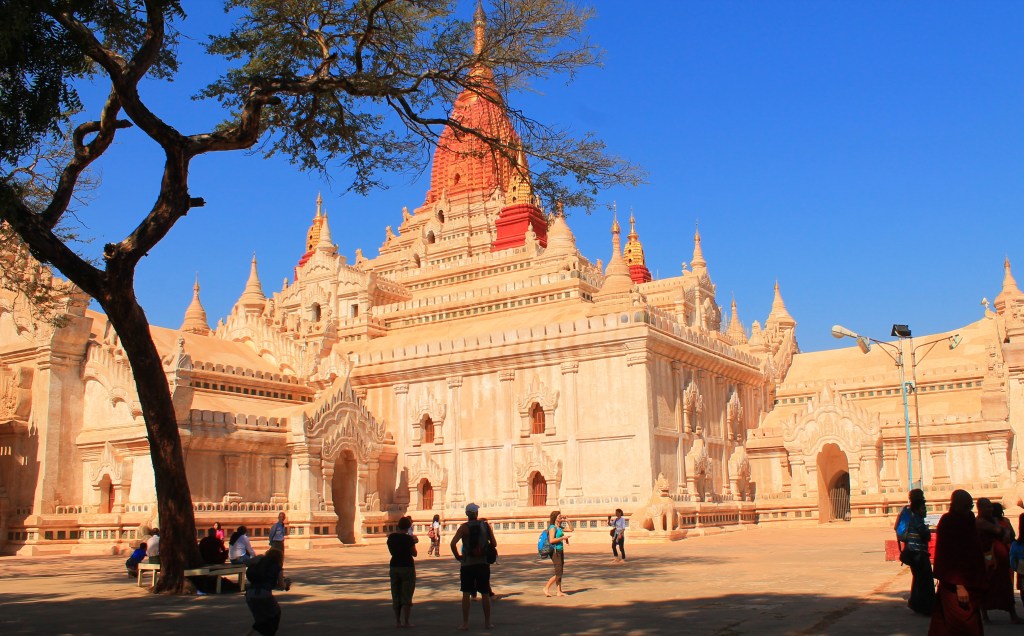
Amanda temple, Burma
In Laos, I visited the historic city of Luang Prabang, where I saw the famous Wat Xiang Thong temple, a Bodhi tree associated with Sri Lanka, and other monuments that reflected the long-standing relationship between Sri Lanka and mainland Southeast Asia.
Over the past few years, I have also spent time in Anuradhapura, exploring its ancient monasteries, stupas, reservoirs, and archaeological sites. These visits revealed not only Sri Lanka’s deep connections with India but also its links to broader trade networks extending as far as the Roman world.
I do not consider myself a religious person. Nevertheless, my travels and reading have deepened my appreciation for the historical role played by Buddhist monks in Sri Lanka. Their efforts preserved the teachings of Buddhism, fostered scholarship, and helped spread Theravada traditions across much of South and Southeast Asia. Their contribution remains one of Sri Lanka’s most significant gifts to the region’s cultural and intellectual history.


மறுமொழியொன்றை இடுங்கள்