FICTION:
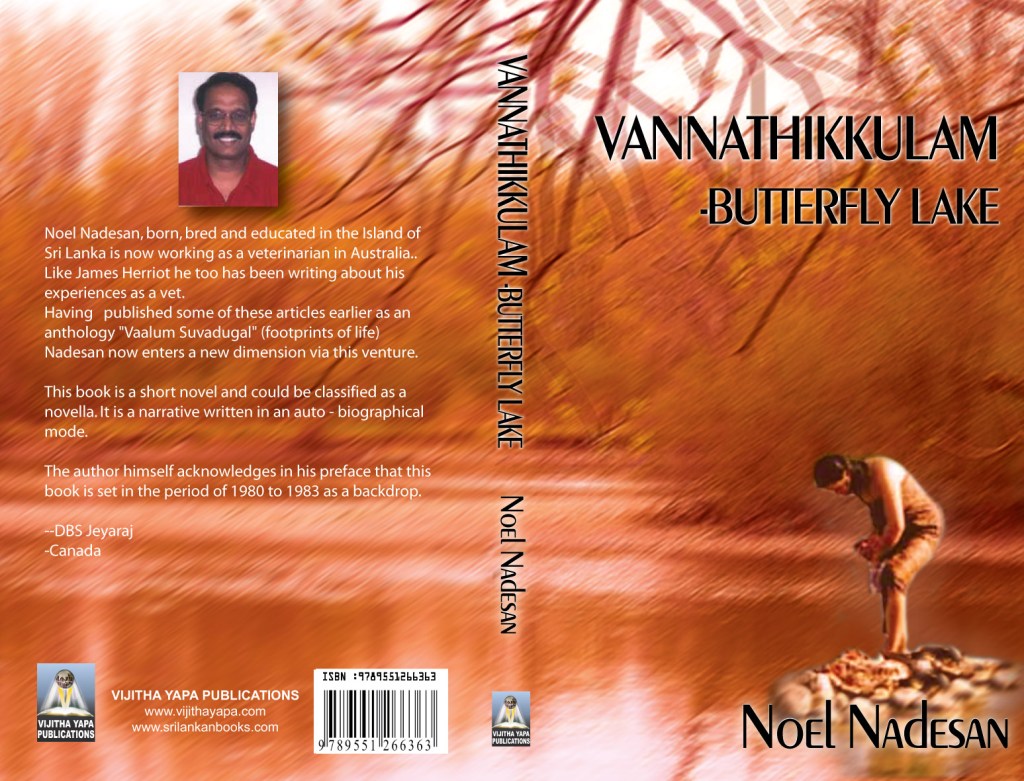
Dr Noel Nadesan, the author of Butterfly Lake, has careered through many roles: a veterinarian who graduated from Peradeniya University, a journalist (he is the Editor of the Melbourne-based Uthayam, a Tamil community newspaper in Australia), a Tamil political activist, and now a novelist.
All these roles play a role in his novelette Butterfly Lake. Naturally, it is not surprising to find a variety of experiences delicately weaving through the novelette, turning it into a rich tapestry.
His biography and fiction meld into an enchanting story of understanding and hope. Normally, Tamil literature tends to be infused with bitter hatred, demonising the majority Sinhala-Buddhists.
The surprising element in Butterfly Lake is the broad understanding of the complex forces that interacted and produced the overdetermining political crisis in which two lovers from two houses (like the Montagues and Capulets in Romeo and Juliet) are trapped.
Dr Sooriyan, a Jaffna Tamil veterinarian, working in a Sinhala village, falls in love with a Sinhala school teacher, Chitra and marries her. But they find that there is no protection for them to live in either the north or the south because of external threats to their lives posed by the volatile communal crisis. So they migrate to a safer haven in Canada.
The storyline is familiar, but the dramatisation of it through intricate details, narrated with a disarming simplicity, lifts Butterfly Lake into an endearing work of fiction.
Surprisingly, within the short space of a novelette, it covers almost the entire gamut of the political forces without being preachy. Like all good narrators, Dr Nadesan tries to maintain a balance, presenting all points of view.
His protagonist, Dr Sooriyan, sees no difference between the Sinhala kings of the past and the present rulers. He articulates the fears of the minority Tamils who have suspicions about the majority. But he doesn’t spare the Tamil politicians and the misguided Tamil youth either.
Dr Nadesan covers most of the political issues without being too dogmatic or losing the impact of the fast-moving narrative. He injects politics unobtrusively as an integral part of the evolving narrative.
Here’s an extract that may shock the partisans who were fixated on Sinhala colonisation of Tamil land: “How can we tell Sinhalese people in Padaviya and Medawachchiya that the Sri Lankan Government had colonised areas where Tamil-speaking people lived by allocating land in these areas to Sinhalese people? Didn’t the Sri Lankan Government allocate jungle lands at Akkarayankulam and Kanagaranyankulam to Tamils? And how many Tamils were prepared to settle down in colonies in Padaviya?
“The fact is that Tamil politicians were not only hasty but also entered the ring without any basic plans. I thought that their actions were tantamount to the actions of an irresponsible man of a family who jumped from a moving vehicle in anger because the conductor of the bus had scolded and assaulted him, yelling at him and his whole family to jump out.” (p. 114).
Overall sympathy
This is where the balance comes in. Dr Nadesan, like Dr Sooriyan (they are congruent except in the love affair), is not a defender of the Sri Lankan government.
The narrator, Dr Sooriyan, shows overall sympathy for the Tamil minority, but unlike other misguided partisans, he is able to assess and analyse where the Tamil political leadership went wrong.
Dr Nadesan’s insights into Tamil politics are valuable to understand the competing forces that bedevilled Tamil and Sinhala politics. In the following paragraph, he sees what went wrong with communal politics on both sides: “The changes that had taken place in Jaffna were clearly noticeable.
During the 1970s, it was possible to travel freely anywhere, day or night. Several vehicles passed through Jaffna roads even around one in the morning, when midnight shows in cinema halls ended. The midnight shows were abolished in the 1980s.
Politics, which dominated conversations during election times then, has now become a daily topic. Tensions erupted everywhere.
Successive governments would need to bear responsibility for creating such tense situations. Generally, the youth were of the opinion that there was no alternative but to resort to violence.
They spoke with more faith drawn from the power of weaponry than in the strength of the masses in their political struggle. It was generally accepted that there should not be any opposing views. They had determined that such opposing views would only destroy unity. I was deeply worried over this state of affairs.” (pp. 39-40)
Fundamental factor
Here, Dr Nadesan reveals a fundamental factor that even the best political analysts ignore. He focuses on the fact that the Tamil militants derive “more faith from the power of weaponry than in the strength of the masses in their political struggle.”
This is borne out by the accumulation of weaponry by the Tamil Tigers, who have, by and large, lost the popular support they had earlier as “boys” by relying on the power of weaponry. Their strength is in the weaponry, and the day that weapons go out of their hands, the Tamil masses can be expected to react differently.
This sole dependence on arms has intoxicated the Tamil youth who brook no dissent. Led by Prabhakaran, they have eliminated the cream of the Tamil political elite. It is, no doubt, a worrying state of affairs. The growing disenchantment with the Tamil separatist movement arises from the violent and authoritarian attempts made by the Tamil Tigers to suppress and oppress dissent.
The strength of the narrative is in exploring these hidden forces, which even the leading sociologists have failed to grasp. Consider the role played by rumours as opposed to the exaggerated claim of the government of the day fanning the flames of anti-Tamil riots. Rumours played a decisive role even in the Sinhala-Muslim riots of 1918.
No one can blame the British for propagandising for either side. When a tiny spark was ignited at the traditional annual Kandy Perahera, with the Muslims trying to silence the drummers as they passed the mosque – a right which the Sinhala-Buddhists enjoyed from the time the perahera began – the rumours spread far and wide, saying that the Muslims had burnt the sacred Temple of the Tooth.
Rumours added fuel to this tiny spark ignited in a Kandy street, and it spread far and wide, bursting into a conflagration that set fire to the whole nation.
Communal riots
Similar rumours played a critical role in stoking communal riots. Here is a passage that describes this common trend: “When I was your age, (says Chitra’s father to Dr Sooriyan, explaining how he came to wear a gold tooth, “the 1958 racial riots took place. Those were the days when we were wandering around without any jobs.
There was news that the Sinhalese had been murdered in Jaffna.
It was rumoured that Sinhalese in Medawachchiya had also been murdered. We were told that the Tamils were coming from Vavuniya in buses and lorries to kill the Sinhalese living in Padaviya.
When we heard the news, the other youngsters and I got together and travelled towards Vavuniya to confront them. On our way, the army stopped us and asked us to go home. We refused. When an army officer attacked me with his rifle, a tooth broke. I still feel ashamed for having believed in the rumour.” (p.98)
The following is a moving incident which encapsulates the other side of the communal violence that broke out sporadically in the fifties, sixties and seventies, mainly as a mob reaction to the confrontational politics of the mono-ethnic extremists of the north.
It also points to the general theme of the book, which gives hope to both communities: “When I was studying at the Peradeniya University, (says Dr Sooriyan) the Sinhala and Tamil students were residing together in the Mars Students Hostel.
At the height of the racial tensions in 1977, hooligans burnt down Tamil shops at Peradeniya Junction. Some Tamils were murdered. Others were forced to flee or sent to refugee camps. As a result, all other students’ hostels were closed down.
Sinhala hooligans
“Nevertheless, we continued to stay in the same hostel. From our hostel, we came to know that Sinhala hooligans from the adjoining village were going to target our hostel that night.
When the Sinhala students heard this news, they immediately broke the legs off all the beds to use as weapons and got ready to counterattack to save us. They also told us to join in the attack. The hooligans had given up their intention when they had heard of the student’s readiness to challenge them.
The Sinhala students deemed us as friends and not as Tamils.” (p. 107) This brings out the book’s underlying theme: the divisions between the two communities are not visceral. The two communities are not divided irrevocably like the Jews and Muslims or even like the Muslims and the Christians, as they have been in history.
There is a traditional bond between the two communities. Except for the lunatic fringe and the die-hards in the majority community, the average Sinhala villager and the elite have responded to the legitimate needs of the minorities with commendable humane sympathy and generous, sometimes even self-sacrificing, responses.
To take one recent example, the Sinhala villagers rushed to the Tamil neighbours in the east with provisions when the tsunami hit them. There was no government, no NGOs, no TRO to help the Tamil victims of the tsunami in the first days of the tsunami hitting the eastern coast. They came later with their respective political agendas.
The response of the Sinhala villagers was not dictated by politics. It was more than a nominal gesture of goodwill, too. It represents the innate human bonds that have tied the two communities together down the ages.
Even though some NGOs and Churchmen pursue insidiously divisive politics, these are two communities that have been brought together by overwhelming historical forces that no man can put asunder.
Dr Nadesan’s novelette gives hope to this common bond that unites the two communities. When Chitra and Dr Sooriyan got married, they tied the indissoluble and indivisible knot. It confirms that both can live together, whatever politics comes in between them. They may even have to leave the country as communal tensions deteriorate. But they leave together to live together, even though their new home is miles away from their native land.
Butterfly eyelids
As the plane takes off the runway, Dr Sooriyan reflects on the past and the future: “This (Sinhala) woman seated next to me had given up her birthplace, relatives and her community. If only those butterfly eyelids could take wing and flutter across the whole of Sri Lanka.
“From my seat, I could not see anything through the window glass.
“Is it the tears in my eyes or the clouds of the sky that darken my sight?”
In conclusion, it is necessary to emphasise that though the emphasis in this review has been on the interweaving politics that have come in between the two communities, this novelette is not a political tract. It is a simple narrative of two lives caught in the vortex of Sri Lankan politics.
Dr Nadesan, who first wrote the book in Tamil as Vannathikulam, got it translated by Kandiah Kumaraswamy. Judging by the flavour of the translation (and not knowing Tamil) I can only guess that there can’t be much of a difference between the two.
It is a narrative of our times and Dr. Nadesan has told it with the power and grace that goes with simplicity. It is a book that should be read particularly by those who think they know what is happening in Sri Lanka.
Asian Tribune
Vijitha Yapa Publications, 2007


மறுமொழியொன்றை இடுங்கள்