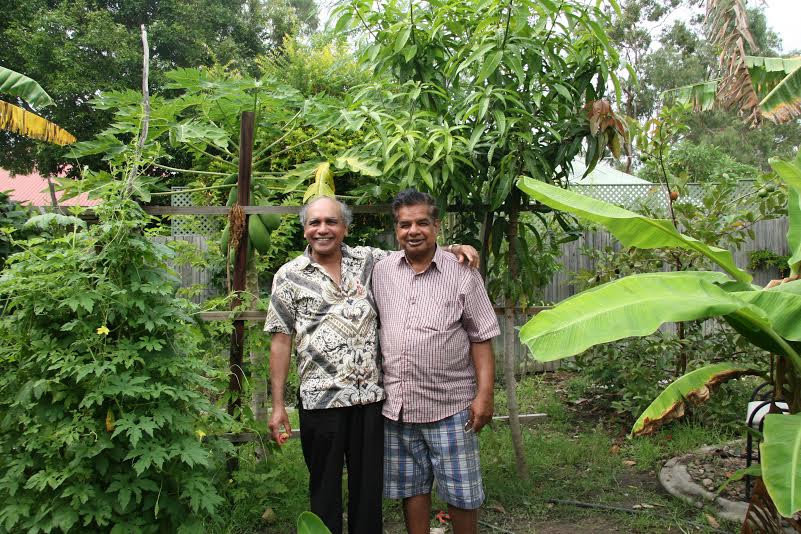
DR Noel Nadesan
Mr Murugapoopathy’s contributions to society can be grouped into three important categories.
A writer, social worker, and social recorder.
No one in the Melbourne Tamil community has covered all three areas simultaneously.
I speak about the first category as the most important one
The forest-dwelling elephant travels long distances in search of water and food. The trails it makes are later used by other animals. In this way, elephants can be seen as the world’s first civil engineers, having carved out the earliest paths through the wilderness.
Similarly, our lives are shaped by the paths carved out by literature. Even those who have never read a literary work in their lives still navigate the moral landscapes it influences.
How?
Even a man with limited personal morals often wishes his wife looked like Sita. He doesn’t necessarily need to know Valmiki or Kambar, the poets who authored the Ramayana.
Similarly, we teach our children that taking someone else’s property is wrong. You don’t need to read the Mahabharata to understand this.
We also believe that all leaders, regardless of gender, must govern justly. Unfair actions by a ruler are believed to lead to their downfall due to their cruelty. Nonetheless, grasping this moral lesson does not necessitate knowing Ilango Adigal or reading the Silappatikaram.
As you know, my wife Shiamala is a medical professional, but she gets annoyed by my literary pursuits. Still, she ordered the Thirukural in an English edition to give to her grandson.
Can you ask the same in Western countries?
Yes — it is the same there as well. Literature has also guided societies in the West. To illustrate this, let me describe three famous Greek tragic plays, collectively known as The Oresteia.
In the story of the Trojan War, after ten years of fighting at Troy, the Greek king Agamemnon returns home. During his absence, his wife Clytemnestra and her lover Aegisthus murder him. They then rule the kingdom for some time.
At the time of the murder, the king’s son Orestes was living abroad. When he returns, he avenges his father’s death by killing both his mother and her lover.
Haunted by guilt over his mother’s death, Orestes seeks refuge with the god Apollo. The issue is then presented to a court presided over by the goddess Athena.
Apollo acts as the advocate defending Orestes. Ordinary citizens sit as the jury. The jurors are evenly split on the decision, and no verdict is reached. In the end, Athena casts the deciding vote and acquits Orestes.
This story was later adapted into three renowned Greek tragedies by Aeschylus, often called the “Father of Tragedy,” collectively known as The Oresteia.
From these dramatic stories arose the concept of trial by jury in courts of law. Before such systems were established, justice was often served through blood revenge.
Thus, the modern system of courts, lawyers, juries, and legal processes did not emerge suddenly. Literature itself played a role in shaping the ideas that guided the development of justice in human societies.
Reasons for honouring Murugapoopathy as a social worker
Education, both a process and a lived experience, helps people see the world clearly, seek truth, broaden their perspectives, and empower themselves. This is what we, as parents, hope to give our children. But what happens when a poor family loses its father—especially during war?
For these children, a gloomy world awaits them, through no fault of their own.
We have always shown deep compassion for those in need. For over 75 years, people across Australia have raised funds and worked tirelessly to support those facing hardship. We endured a brutal civil war for more than 30 years, followed by natural disasters like the tsunami and repeated floods.
Natural disasters like tsunamis and floods are beyond human control, and to some extent, their destruction is unavoidable. However, war is different. War stems from political failure. Politicians govern the country, impoverish it, and enrich themselves. Yet, we, the Sri Lankan people, elect them repeatedly, often without hesitation.
I am talking about the Ceylon Student Education Fund, which supports the education of war-affected children through Year 12.
In 1988, my friend L. Murugappoathy, along with a small group of like-minded individuals, founded the Ceylon Student Education Fund, with Murugappoathy as its driving force. Its mission was simple yet profound: to educate orphaned or displaced children.
Back then, he was a refugee in Australia, separated from his family in Sri Lanka. While many worried about their loved ones, he took action. He helped start an organisation that first supported students in the North and East of Sri Lanka and later expanded to the Upcountry. The fund has been running continuously for 37 years.
Although Mr Murugappoathy is currently incapacitated by illness, his legacy remains remarkable. Almost 5,000 students have received educational support through this program. Many have gone on to complete university degrees and now hold esteemed positions in Sri Lanka and internationally.
I take pride in what this organisation has achieved. Unlike many short-term interventions, we helped students help themselves—by investing in their futures. At a time when many were collecting funds for arms, Mr Murugappoathy chose to gather funds for education.
This foresight was remarkable. His vision can be compared to Swami Vipulananthar’s establishment of a school in Batticaloa—a belief that education is the most potent instrument of social transformation. Today, countless adults across Sri Lanka, working in every sphere of life, stand as living testimony to Mr Murugappoathy’s quiet but profound contribution. It proves that a single individual, with clarity of purpose and thoughtful execution, can indeed bring about meaningful change in this world.
The third and last one is a social recorder.
As Tamils, our historical record in this area is limited, unlike that of the Sri Lankan Sinhalese, who have a documented 2,500-year history, according to Buddhist monks. Rather than recognising their own deficiencies, our people tend to dispute this history.
Every society requires someone to record its people and events. Mr Murugapoopathy has documented numerous individuals and incidents not just in Melbourne, but also across India and Sri Lanka.
I can say many things, but not here due to time constraints.
I am honoured to present Mr Murugapoopathy’s achievement to you here. Thank you.
 Noelnadesan's Blog
பின்னூட்டமொன்றை இடுக