Ragala, nestled in Sri Lanka’s hill country, was a town sustained by human effort, surrounded by greenery, rich in natural resources, and crucial to the national economy. It was here, in the Liddesdale Tea Estate, that I worked for a short while after the ethnic riots of 1983.
From my veterinary quarters, I would wake each morning to a view that stretched endlessly before my eyes—a rolling green carpet across the hills. Though Mother Nature cloaked the tea bushes in frost overnight, the morning sun would lift that veil with its rays, as a bride removes a garment after her first night. To capture such beauty, one would need to search for words, even in the richness of any tongue. Yet beneath that shimmering veil lay a history steeped in pain: blood, sweat, and tears that could not be hidden, writhing like a worm beneath the surface.
The British, during their long years of colonial rule, left scars that still spark conflicts worldwide. In Africa, the Middle East, and Asia, they drew borders on maps with careless strokes of a pen, tearing apart nations, communities, and families. We read about states and wars in newspapers, books, and on television. But the private unravelling of human relationships—the slow destruction of families—remains unspoken, never headline news. It was in my work as a veterinary surgeon that I encountered one such story, and through it, glimpsed the hidden fractures within a community.
In Sri Lanka’s hill country, the British uprooted labourers from the southern districts of Tamil Nadu and transplanted them onto the estates. Many died along the way, succumbing to disease and wild animals. Those who survived worked for generations—more than a hundred years—shedding blood and sweat, denied rights, working only to feed themselves. When the British left, the new rulers of independent Sri Lanka stripped these people of their citizenship, making them stateless and deporting many back to India. Some remained behind, continuing to work on the estates, faceless hands feeding the nation.
It is their story that I now make my own.
I only spent six months as a government veterinary surgeon in Ragala, a few kilometres from Nuwara Eliya. But from there, my little story begins.
My veterinary hospital sat on a hill within the estate. Each morning, I woke to the sight of women bent over tea bushes, plucking tender shoots, and men swinging their blades to slash weeds. During those months, I became acquainted with several estate superintendents. After independence, the white masters had left; brown masters took their place. Only the colour of their skin had changed. In manner, dress, and behaviour, there was little difference.
Among them, one stood out—Kandasamy from the north, who managed the Golden Estate. At that time, Tamils who rose to such positions were rare enough to be counted on one hand.
When I visited the Golden Estate to see his Alsatian dog or his cattle, I was always welcomed with his generous hospitality. Sometimes I even stayed overnight in his sprawling bungalow, returning only the next day.
There was one inconvenience to staying there: the bungalow had many rooms and many doors, and finding the one that led to the bathroom was a puzzle. After heavy dinners, with food and liquor, if I had to get up in the middle of the night, I moved cautiously—lest I open the master’s bedroom door instead of the bathroom. Before each stay, I would carefully memorise the layout of the house to avoid mishap.
One evening, after he had sent his car to pick me up, I was chatting with him when two white men walked in. He called them in Tamil, “Thurai” (Sir). They had golden hair, golden moustaches, pale English skin — but they were wearing sarongs and were barefoot.
I was startled. White men, dressed in sarongs, speaking Tamil? They seemed like beings from another world. Yet they spoke Tamil fluently—the hill-country dialect, though softly. Occasionally, they also used the word Thurai.
Kandasamy introduced them as Ramu and Balu. What happened next surprised me even more. Their news made me and Kandasamy hurry to the cattle shed with my medicine chest.
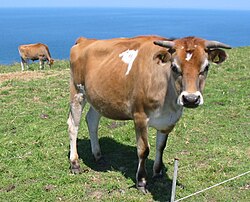
A Jersey cow named Ponni was struggling in labour. The calf’s legs protruded, but not its head—a malpresentation. Ponni lay on her side, groaning, with the floor damp and smeared with dung.
By the torchlight, I saw the calf’s legs and knew I had to act quickly to save both mother and calf. The water bag had burst—they said only five minutes remained. With no electricity, I asked for a Petromax lamp, hot water, and dry hay to spread over the floor. I also requested a strong rope from Balu.
While they went off to find these, Kandasamy handed me a sarong. I changed and injected Ponni with a spinal anaesthetic. I explained that the calf’s head was twisted, then flushed soap water into the birth canal and carefully repositioned the calf. I tied the rope around its hind legs and instructed Ramu and Balu to pull alternately while I kept flushing soap water and gently manoeuvred the calf with my hands. After a fifteen- or twenty-minute struggle, a black-and-white male calf slid into the world.
I gently swung it by its hind legs, cleared its airways, and then turned to Kandasamy:
“Why did you cross a small Jersey cow like Ponni with a large Friesian bull?” asked Ramu.
He looked at me sheepishly.
“These two,” he said, nodding at Ramu and Balu. “They brought a bull from the neighbouring estate, saying they wanted to try crossbreeding.”
The twins acknowledged their mistake with heads bowed.
Ponni licked her calf, and peace returned. Back at the bungalow, I asked Kandasamy to tell me the story of Ramu and Balu, the white-skinned ones.
About thirty years ago, a Scotsman arrived as the superintendent of this estate. He lived with a Tea Plucker named Mariamma, keeping her in the bungalow as his wife. These twins were born of that union. When they were four years old, the Scotsman went to England for a holiday and died in a car crash. Mariamma left the bungalow, returned to plucking, and raised them on the estate. A few years ago, she too passed away.
He finished his story.
But my mind was full of thoughts.
How much suffering Mariamma must have endured. Living for four years in the superintendent’s bungalow and then returning as a labourer on the same estate—could she have borne it? During my college days, we used to tease a fair-skinned student by calling him “boiled prawn.” I wonder how Ramu and Balu must have been mocked at school.
I also recalled reading about children born to American soldiers and Vietnamese women, and how many of them were later resettled in America.
These thoughts dispersed into the air like clouds during Kandasamy’s feast. In the end, I remember saying to him: “It is hardly surprising that Ramu and Balu, themselves children of crossbreeding, sought to repeat it through Ponni.”
 Noelnadesan's Blog
பின்னூட்டமொன்றை இடுக