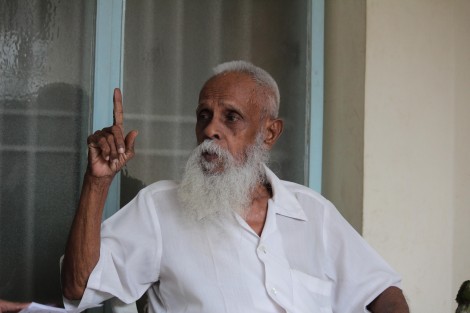
It was midday when Sandathiyar, the second-in-command of PLOT, arrived at our office on Choolaimedu Street with David Ayya. At that time, Dr. Sivanathan and I were working there. We had already met both men in previous encounters, but that day, they appeared deeply agitated.
I mostly stayed silent, listening as Sandathiyar spoke. Their conversation centred around the internal killings within the movement and the increasingly autocratic behaviour of PLOT’s leader, Uma Maheswaran. I had heard that Sandathiyar was a principled and honest man, and I respected him for it.
Around that time, he published a small booklet titled ”The Lesson Taught by Bangladesh,” in which he openly criticised the People’s Liberation Organisation of Tamil Eelam (PLOT) and condemned India’s misguided foreign policy. Many saw it as a bold, anti-India stance. I, too, found the ideology troubling. Even then, I was convinced: Sri Lankan Tamils could never achieve progress by opposing India.
As they discussed the factional violence within the movement, neither of them acknowledged my presence. At last, I gathered the courage to ask Sandathiyar a question.
“Of course,” he said. “Go on.’
“You were very close to Uma Maheswaran,” I said. “You helped elevate him to his current position. Given that long association, didn’t you ever get the impression that he was turning authoritarian?”
He paused before replying, “There’s truth in your question.” Then, rising to leave with David Ayya, he added, “I don’t know if we’ll ever meet again.”
That parting remark deeply unsettled me.
Dr. Sivanathan once mentioned that Sandathiyar was the only honest man among PLOT’s leadership. A few days later, we received heartbreaking news. One night, a group from PLOT came looking for Sandathiyar. Mistaking David Ayya for him, they tied him up, stuffed him into a sack, and took him away. After realising their mistake, they left him near a cremation ground in Anna Nagar, Chennai.
Afterwards, David Ayya published a daring and widely circulated article titled Murderer Mukundan and His Partner Vasu. In it, he directly named Uma Maheswaran and a man called Vasudeva from Batticaloa. We admired his courage. That article played a crucial role in Uma’s eventual downfall.
Although he narrowly escaped death at Uma’s faction, David Ayya survived for another thirty years. In contrast, Sandathiyar disappeared just days after the abduction attempt.
At one point, PLOT positioned itself as a progressive organisation with clear policies, international links, and training from the PLO. With over 6,000 trained cadres, it showed real promise. But ultimately, the organisation fell apart — not because of the LTTE, but due to its own self-destruction.
By July 1987, as I was preparing to leave India, my Sri Lankan passport had expired for nearly three years. I managed to renew it with the help of an Indian intelligence officer I knew. One day, he showed me a confidential list of assassinations carried out by Tamil groups in India.
According to that list, PLOT was responsible for more than 250 killings. The LTTE had committed 32; TELO, 18. There was no data for EPRLF or EROS. Around the same time, I heard about four people killed by EROS in Madurai—an incident also recorded in the officer’s notes. Many other killings likely went undocumented. That list, dated mid-1987, coincided with the signing of the Indo-Lanka Accord.
After I moved to Australia, I bumped into David Ayya again when I was visiting India. It was clear that he remained a committed Tamil separatist, to the extent that his views nearly bordered on ethnic hatred towards the Sinhalese. Maybe that’s why he eventually placed his trust in the LTTE.
Though a Christian, David Ayya lived like a Hindu ascetic. He never married, and his discipline extended even to his dress. Perhaps he wore shoes during his university days in Australia and England, but I never once saw him wear footwear in India.
Dr. Sivanathan used to joke, “Ayya will only wear shoes once Tamil Eelam is achieved.” To this day, I don’t know if that was meant as a joke or prophecy.
David Ayya saw himself as a spiritual recluse within the Tamil separatist movement. However, his idealism often masked a certain political naivety. He started with the noble ideals of Gandhism, but failed to carry them through, ultimately handing them over to armed militants: first Uma Maheswaran, then the LTTE. Until the end of his life, he remained a stubborn idealist, convinced—like a yogi—that liberation would come, while childishly building walls of fantasy around himself.
Everyone involved in the Eelam struggle faced some form of defeat. Some managed to recover, while others gained materially and quietly moved on. But I often wonder how much inner torment David Ayya endured in his final days.
We must remember David Ayya, the architect and founder of the Sri Lankan Gandhian Movement. But how should we remember him?
In our culture, remembering the dead is a sacred duty. For those who knew and loved him, his passing is a personal sorrow. But we must reflect not with emotion, but with clarity.
He lived like a sage and died a natural death. As a Sri Lankan Tamil who chose a public path and remained unmarried, his life and legacy merit thoughtful reflection.
He studied architecture at the University of Melbourne, one of the world’s top institutions, in the 1950s. Later, he specialised in urban planning in England and spent some time working in Kenya. During the wave of post-1950 global urbanisation—particularly outside the West—he became a prominent figure.
The Gandhian Movement he co-founded with Dr. Rajasundaram was the first volunteer organisation supported by overseas Tamils. It focused on resettling stateless plantation Tamils by helping them secure land—a truly remarkable achievement.
Sri Lankan Tamil politics has largely followed three paths:
1)Those who clung to power until death.
2)Those who pursued personal wealth.
3)Youth who gave their lives in emotional sacrifice.
David Ayya did not fit into any of these groups. Instead, he gave up both himself and the Gandhian ideals he used to stand for. His intelligence and education ultimately let him down.
In many countries, disillusioned activists turn to voluntary service. Others establish NGOs as fronts for fundraising. The LTTE, TRO, and TAMMED all maintained such fronts in Australia.
It was David Ayya who turned a genuine volunteer group like the Gandhian Movement into a militant-supporting organisation. That change reveals a lot about the personal sincerity—and political naivety—of many talented, educated Tamils. David Ayya was one of them.
A friend of mine, an engineer who had studied with him at the University of Melbourne, often spoke about him. “I knew Ayya well, too,” he would say. “He clung stubbornly to the dream of Tamil Eelam and endured immense hardship for it. But I never believed in his politics.”
That friend from the Hill Country shared my view that the Tamil struggle never really included communities outside the North and East. Around 2005, he showed me a letter David Ayya had written. One line stuck with me: “All of us Tamils have now loaded every burden onto Baby brother Prabhakaran’s young shoulders. He cannot carry it alone. Overseas Tamils must help ease that load.”
After reading that—and later his biography—I found myself reflecting on the David Ayya I had met many times but had never written about, until now.
I first met him through Dr. Sivanathan. When Tamil militant prisoners escaped from Batticaloa Prison, David Ayya was among them. Two groups—PLOT and EPRLF—both claimed responsibility via leaflets. At the time, Dr. Sivanathan was a government doctor in Vakarai. He helped the escapees and had to flee Sri Lanka shortly afterwards. The prisoners were divided among the groups and sent to India. Dr. Sivanathan, who came with the PLOT group, stayed in a refugee camp run by them in Theni, near Madurai. He admired David Ayya greatly. Although he later cut ties with PLOT, he kept personal relationships with some of its members.
It was Vasudeva—the same man named in David Ayya’s article—who appointed Sivanathan as treasurer of the Tamil Medical Fund (MUST). Dr. Rajasundaram’s wife, Dr. Santhi Rajasundaram, was made deputy head. Santhi worked at Egmore Police Hospital in Chennai and had no political ties.
At the time, Sivanathan was regularly disturbed by reports of PLOT’s internal dysfunction. He would slap his forehead and say, “There’s no fixing these people.”
Each day brought news of disappearances and factional killings. As PLOT descended further into chaos under Uma Maheswaran’s leadership, Sivanathan would recount what he had heard, then unleash a string of curses aimed at Uma.
 Noelnadesan's Blog
பின்னூட்டமொன்றை இடுக