The Cholas once adorned their flag with a tiger, a symbol of the wildlife in South India. Yet, Sri Lanka, with its leopards, lacked this majestic creature. This posed an intriguing question: why did the Tamil Eelam tigers (LTTE) choose the tiger as their emblem? Similarly, flying a lion flag in a country without lions also seems paradoxical. In Africa, lions and leopards dominate the landscape, but only in India can one find all three — the lion, the tiger, and the leopard — coexisting. As someone deeply fascinated by these creatures, I’ve long dreamed of seeing them up close.
On a previous visit to Periyar Tiger Reserve, I couldn’t even spot a tiger after a whole day’s search. All I saw were tiger droppings, and in Nepal, a guide pointed to claw marks on a tree, suggesting a tiger’s presence. Despite numerous attempts, sightings remained elusive. One friend had visited eight tiger reserves in India, only to leave empty-handed. Undeterred, he convinced me to join him for a two-day stay at Kanha Tiger Reserve, located in Madhya Pradesh.Arriving directly from Kashmir, a region fraught with political tensions, the Kanha Reserve felt like a safer haven.
The accommodations were comfortable, and the food satisfying.At 6 a.m. the next day, we set off in jeeps, armed with our permits. The dry season, though harsh, provided the best opportunity to spot tigers, who often venture to waterholes.
We spent hours navigating the reserve. Peacocks, deer, and buffaloes were abundant, but I remained fixated on one goal: finding a tiger.We were specifically looking for Bengal tigers, the apex predators of the Indian forests. With an estimated population of 3,000 to 3,500 tigers in India, they are critically endangered despite legal protections in sanctuaries.
Historically, tigers are believed to have arrived in India from Siberia around 12,000 years ago, during the post-Ice Age period, when the landmass was divided by the sea.The Decline of Tigers, several factors have contributed to the decline of tiger population.
1. Human Encroachment: As human populations grew, forests were destroyed to make way for settlements and agriculture.
2. Hunting: Indian kings and later British colonists hunted tigers for sport. Their skins were often displayed as trophies. Even today, tiger skins can still be found in some royal palaces.
3. Negative Perception: The media has often portrayed tigers as ferocious man-killers. In reality, only old and injured tigers venture into villages in search of easy prey.
4. Low Reproduction Rates: Tigers live for only 10–15 years and reach reproductive age only after 4–5 years. Their gestation period is 3.5 months, and a mother can only raise 1–3 cubs at a time. Some male tigers even kill cubs to mate with their mothers, further limiting the species’ growth.
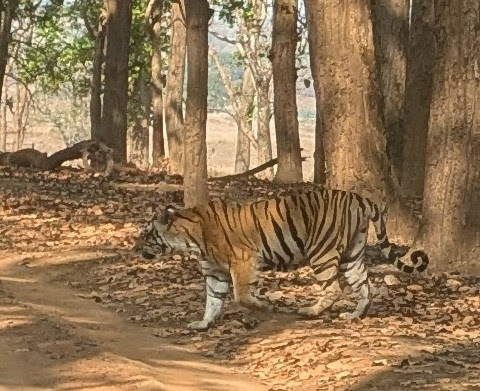
By midday, we hadn’t yet spotted a tiger. But as we returned from our evening drive, something unexpected happened. From under a tree just a few meters away, a tiger silently emerged. It walked toward our vehicle, seemingly without fear. Its bulging belly suggested it was a female. This moment, witnessing a tiger in its natural habitat, felt almost surreal. It was a reminder of the tiger’s vital role in maintaining the balance of the forest.
In the midst of all this, we also encountered a Barasingha deer, native to North India. The deer gleamed in the morning sunlight, an endangered species in its own right. It was a beautiful moment that reminded me of the tales of the golden deer in Valmiki’s Ramayana and Kambar’s Kambaramayanam.
We returned back with immence satisfaction.
 Noelnadesan's Blog
பின்னூட்டமொன்றை இடுக