Since I could only take a train to Chennai the following evening, I had to spend the night in Rameswaram. To my surprise, I found a hotel room for just ten rupees. In Sri Lanka, hotels that were affordable for ordinary people didn’t exist. In Jaffna, during our time, hotels didn’t even offer accommodation. But the room I got in Rameswaram was clean, had a bathroom, and suited my needs, even if the bed was a little small.
When I woke up the next morning, I realised I had at least twelve more hours to spend in town. Since I was already there, I decided to visit the temple mentioned in the Ramayana. It wasn’t far, and I had never seen such a grand temple before in my life.
As I wandered among the temple’s mandapams and stone pillars, a stout, dark-skinned man in a dirty dhoti appeared in front of me. He had a large pot belly and carried a small brass vessel. He offered me water, saying it was “Ganga holy water.” I didn’t believe in such things, but I drank it out of politeness. Then he brought water from another well, calling it “Saraswati holy water.” I couldn’t refuse that either. And so, it went—I ended up drinking nearly twenty-five varieties of “holy water.”
The man didn’t let me enter the inner sanctum of the temple. I couldn’t brush him off—his persistence, his body language, all held me back.
On my very first day in a new country, I couldn’t bring myself to act rudely or show anger. But I remembered a saying from our village: “A woman who never frowns at men will stay forever pregnant.” I felt like my stomach had filled up just from all that water. The man finally left me alone only after we stepped outside the temple. In my mind, I had “murdered” him several times by then.
The whole incident made me think: getting caught by the Nuwara Eliya police back in Sri Lanka might’ve been better than this. When he finally asked me for twenty-five rupees, I refused. “Why should I pay for water I didn’t ask for?” I told him. But arguing with him was pointless. I gave him ten rupees and walked away, resolving never to enter a temple again. I kept that promise for the next three years I spent in India. Whether in Chidambaram, Madurai, or Trichy, I avoided temples. If my wife and children went in, I stayed outside, guarding their footwear.
In Sri Lanka, despite my disbelief, I still visited temples. But in India, that changed. That evening in Rameswaram, I returned quickly to my room and lay down, lost in old memories and political stories. When you’re alone, only memories stay with you.
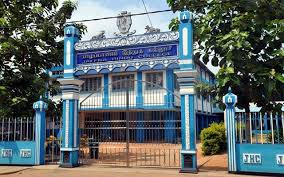
Jaffna Hindu College stands on Kankesanthurai Road—that’s where I studied. From the upper floor, we could watch the road below. In the 1970s, I heard there was a student union procession one day. I was in the college’s botany lab with my classmates. Senior students from other schools marched past the road, accompanied by drums and effigies. The protest had no police permission, and many feared a crackdown.
We stood by the lab window, trying to spot anyone from our school. Some students carried an effigy of the education minister, Badi-ud-din Mahmud, made from straw. To my surprise, my classmate Selvavadivel was right behind the effigy, smiling, beating a drum, and looking up at us. I felt sorry for him. I feared the police would beat him. But the next day, he met me looking proud and unhurt. Only then did my worries ease.
Most of us believed that, regardless of our exam results, we’d somehow be accepted into university. If not in Sri Lanka, then in India or the UK. With that mindset, we never believed in protests or processions. We lacked the strength, or perhaps the courage, to take part. That’s why seeing Selvavadivel marching that day surprised me. His thinking must have been different. Even now, I remember his smile. Unique people and rare events leave deep impressions; ordinary ones pass by like river water. Many avoid protests. But sometimes, circumstances drag people into them. Just like only one in twenty of us joined that protest, 95% tried to stay away. For many, life itself was already hard enough.
At the same time, there were those who, without risking anything, would incite others. I remember the fiery speeches of Vannai Anandan and the blood-stirring rhetoric of Kasi Anandan. Their words lit a fire in our generation. Today, thousands of Anandans speak online. But back then, you had to show up, speak publicly, and be prepared to face imprisonment.
In the 1970s, politics followed us like a shadow, an inescapable presence. Not attending school on Republic Day and urging others to boycott became our first political act.
Two incidents from that time remain etched in my memory. One was told to me; the other, I experienced firsthand.
During the first Republic Day boycott at Vaitheeswara School, students refused to attend. The principal pleaded with them to come in peacefully. But when stone-throwing began, an old man on a bicycle passing by said, “Boys, why are you throwing stones at the school you study in? If you must, throw stones at that Sri Lanka Transport Board bus instead!”
Like Moses leading the Israelites out of Egypt, those stones meant for the school were hurled at government buses instead. As far as I know, that was the first politically motivated stone-pelting in Jaffna. After that, SLTB buses were smashed and burned across the region.
The second incident happened around 1975. Hindu College students boycotted school on Republic Day. For us, it was easy—we studied mainly through tuition. Our zoology teacher, Mr. Francis, taught us both at school and privately. But students at St. John’s College, who relied more on regular schooling, didn’t want to join the boycott.
After our successful boycott, my friend Sundaresan and I went to see if St. John’s students had joined. Sundaresan was short and climbed onto St. John’s compound wall to peek in. Just then, a police jeep pulled up. Four constables and an inspector surrounded us. We froze.
The inspector grabbed Sundaresan by the hair and barked in broken Tamil, “What did you write?”
Someone had already scrawled “Boycott Republic Day” on the wall in red paint.
“I didn’t write it,” Sundaresan pleaded.
When the inspector raised his hand to hit him, Sundaresan cried, “Sir, this is not right!” The fear on his face and body language was unforgettable—he looked like a prawn curling in a cooking pot.
Seeing him crouch like that, I couldn’t help but laugh. Just like Valluvar said, “Smile in times of distress,” I laughed—much to the anger of both the police and Sundaresan.
The inspector didn’t like it. “Which school?” he snapped.
“Hindu College.”
“Then why are you here?”
“To visit a relative.”
“What’s the address?”
I gave the address of my girlfriend’s (future wife’s) house, which was near St. John’s College.
“Run away!” the police shouted, chasing us off.
After that, whenever someone met Sundaresan, they’d tease him: “Sir, this is not right.”
And so, I return from Jaffna to Rameswaram.
That evening, I boarded the train to Chennai. It was a long journey. Watching people and faces is my favourite pastime—perhaps that’s where my desire to write was born.
When I stayed at the Jaffna Hindu College hostel, films were just beginning to shift from black-and-white to colour. Cinema overwhelmed me then. I even dreamt of working in a theatre—I loved films that much.
On the first day back after hostel holidays, there were no time restrictions. I once watched three films in a single day. Thanks to South Indian cinema, I had a vivid, colourful image of India—not just colourful clothes, but also red-and-white shoes like the ones worn by MGR and Sivaji.
In Tamil storybooks, dark-skinned people were often described as “wheat-coloured.” But to me, wheat meant wheat flour—how could someone has skinned the colour of that?
You might ask, “Didn’t you read Jayakanthan’s stories?” Yes, I did. His characters came from the slums. However, I still expected Indians to resemble film stars.
On that train journey, I didn’t see a single man in a suit or coat. I’m not joking. That’s how much cinema and literature have shaped our expectations of India. And I was there, watching it all unfold.
To be continued.
 Noelnadesan's Blog
பின்னூட்டமொன்றை இடுக