Odyssey of War.
13 Sep 2024 | BY Rajeswary Balasubramaniam
- A review of Dr. Noel Nadesan’s ‘Odyssey of War’
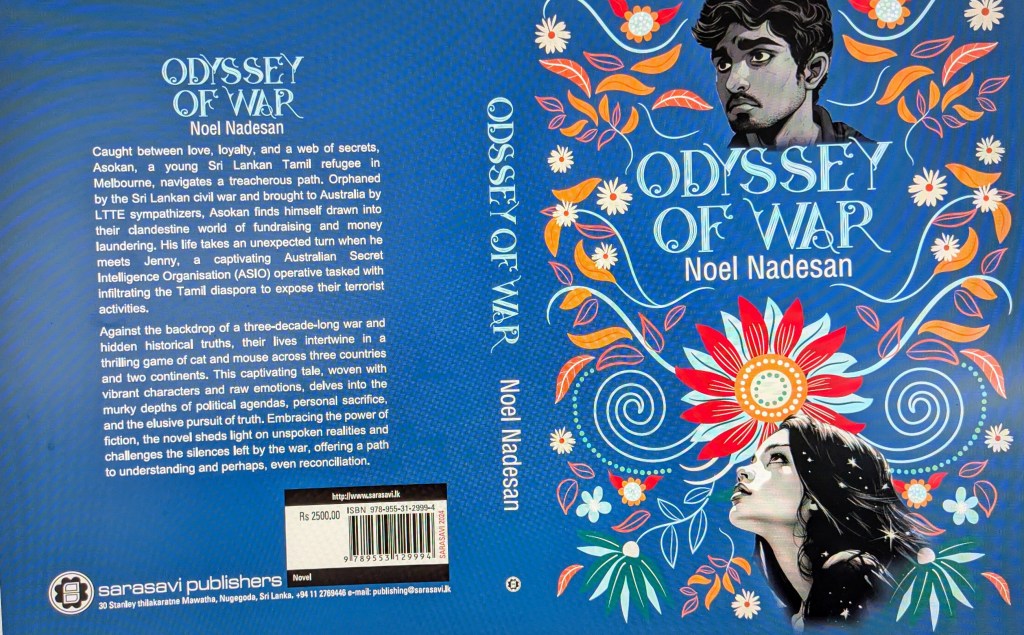
The ‘Odyssey of War’, a novel by Dr. Noel Nadesan published by Sarasavi Publishers, reflects the struggle for the liberation of Tamils in Sri Lanka (1977-2009) and the failure of interwoven world politics. The novel illustrates how upper-class Tamils overcame caste, religion, and regions and united for the liberation of Tamils, but went beyond the spirit of liberation, migrated, and eventually made the liberation struggle of Tamils a profitable business.
‘Odyssey of War’ shows how the struggle of the Tamil freedom fighters, avatars armed with many great expectations to save the Tamil nation, suddenly perished in ashes.
The novel dissects the vital parts of the struggle as a doctor and conducts an autopsy to find the cause of his death. ‘Odyssey of War’ will be a great resource for the future generation to study the Sri Lankan Tamils’ struggle.
‘Odyssey of War’ is the story of Asokan, an eight-year-old boy whom Indian soldiers orphaned on 16 October 1987, and a wonderful Tamil family who adopted him and raised him as their son. The novel follows his relationship with Jennifer, claiming to be of gypsy heritage and telling Asokan the history of gipsies who migrated from India to many Western countries; telling Asokan that both have a subcontinental connection.
But this is not only Asokan’s story. This is the sad history of many Tamils of that generation and the cruel, inhumane, egoistic activities that have been covered up as things that cannot be talked about openly. It’s also the story of Ganesan, a childhood friend of Asokan, chased out of the town due to caste atrocities. It’s the story of Gunam, a young man shot dead by the Liberation Tigers of Tamil Eelam (LTTE), as recorded in Asokan’s uncle’s diary. It’s the story of Selvi who volunteered to sacrifice her life and future for the liberation of the Tamil people, her beloved Karthika, and the consequences of the failure of the LTTE.
Some of the characters in this story may cause discomfort, as they highlight how religious, educated, and wealthy members of the Tamil community in many countries helped the LTTE by turning a blind eye to their deadly actions. The atrocities of the LTTE intensified because no one spoke against them. The novel asks the reader to reflect on whether they were also a party of perpetrators of injustice, ultimately seeking an end with weapons and destroying the entire society.
In this story, along with the expressions of individual feelings of love, are caste and class oppression; intimidation by various powers; betrayal; and the greed of Tamil nationalists who used the money raised for the Tamil community for their own benefit – the subjects are discussed in a heated manner.
The LTTE, an armed group that has been widely talked about across the world during the last 30 years, in May 2009, was quelled by the military forces. Using Asokan’s story, this novel considers the question of whether one of the reasons for the serious failure of the LTTE was the lack of political vision of the LTTE or Tamil society and media, who congratulated the LTTE for the benefit of their own lives.
The author advances the view that the LTTE did not understand that Sri Lankan Tamils are one of the communities that have suffered on the world stage, caught in the hypocrisy of Western governments who did not consider anything except their geopolitical needs.
In the late 1970s, Western powers meddled in countries like Pakistan, Afghanistan, and Sri Lanka, and they supported the Sikhs’ independent state in India through Khalistan. So, India trained many Tamil groups in anger at the Sri Lankan Government, the darling of the West. Those Tamil groups fought among themselves.
The LTTE killed the Prime Minister of India (1991) and made enemies of the liberation war of Tamils. After the September 2001 bombing of the Twin Towers in America, Western governments moved away from the concept of ‘Tigers as freedom fighters’ and saw them as terrorists.
Reflected in the diary of Asokan’s uncle are stories about beatings and killings in Tunukai, where the LTTE is said to have had the largest concentration camps, about which there are many stories of their torture of Tamils.
Looking at the Tamil people living as slaves under the control of the LTTE and suffering due to the continuation of the civil conflict, the ‘Odyssey of War’ describes them as ‘deer wandering in a desert looking at a mirage channel’.
After reading this novel, you will understand how much the author cares about humanity, ethnic unity, and peace activities in many places. This novel is not an ordinary novel, but a critical reflection on the most important period of the Sri Lankan Tamil struggle.
(Rajeswary Balasubramaniam [Rajes Bala] is a writer, journalist, human rights campaigner, independent filmmaker, and community social worker. She was born in Eastern Sri Lanka, and is currently residing in North London)
…………………………………………………………………………………
The views and opinions expressed in this column are those of the author, and do not necessarily reflect those of this publication
The Morning.lk
 Noelnadesan's Blog
பின்னூட்டமொன்றை இடுக